
Montessori Material Recommender
Select your child's age group and their current interest to discover suggested learning materials.
Suggested Materials:
Please select both an age group and an interest to see recommendations.
Key Takeaways for Parents
- Focus on realism and natural materials over fantasy and plastic.
- Toys should have a "control of error," meaning the child can see if they made a mistake without an adult telling them.
- Less is more; a few high-quality options prevent overstimulation.
- The goal is to move from concrete objects to abstract concepts.
The Philosophy Behind the Materials
To understand the toys, you have to understand Maria Montessori. She was an Italian physician who realized that children aren't empty vessels to be filled with information, but active explorers. In her view, the environment is the "third teacher." If you give a child a toy that only does one thing (like a plastic phone that plays a song when you press a button), the child is a passive observer. But if you give them a sensory toy like a set of textured fabrics, they become the active experimenter.
This approach relies on the "absorbent mind." From birth to age six, kids soak up everything around them. Montessori materials are designed to isolate one single concept. For example, if a child is learning about size, they won't use blocks that are different colors and different sizes. They'll use blocks that are all the same color but vary in size. This prevents the brain from getting confused and allows them to master one skill at a time.
What Actually Makes a Toy "Montessori"?
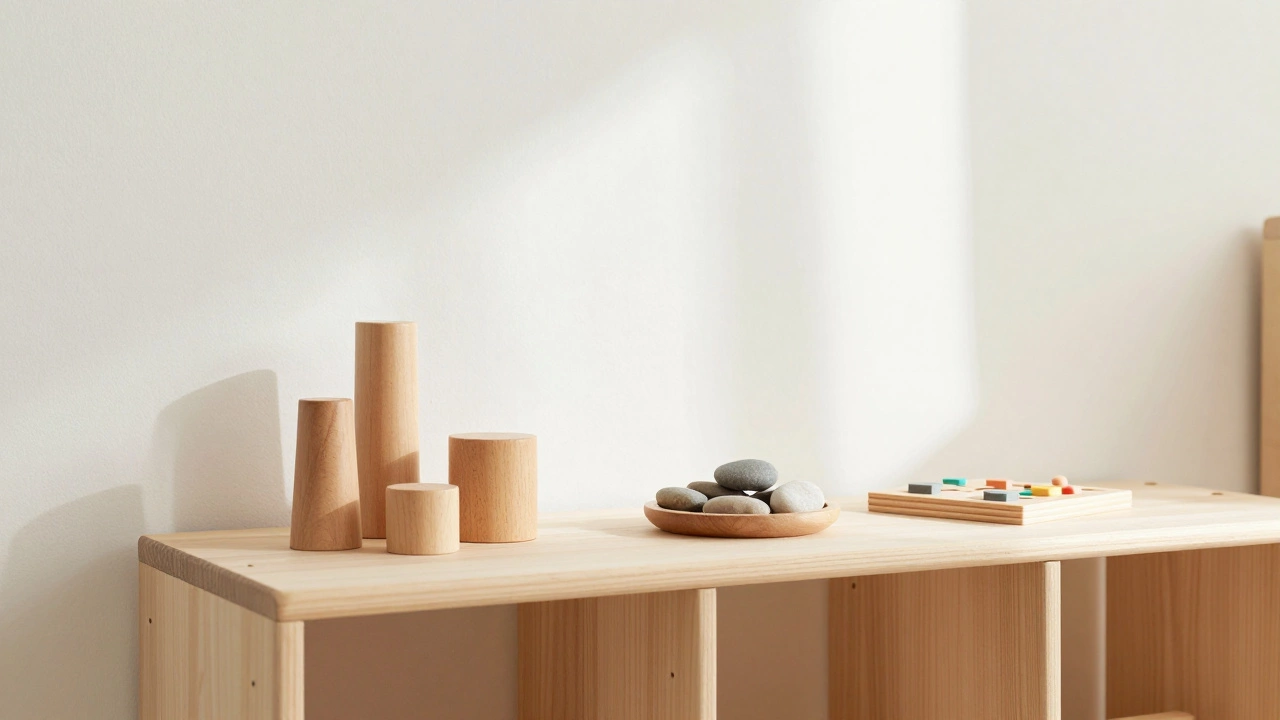
You'll see a lot of products marketed as "Montessori-inspired" today, but true materials follow a few strict rules. First, they are usually made of natural materials. Wood, cotton, metal, and glass are preferred because they provide a rich tactile experience. A heavy metal cylinder feels different from a light wooden one, and that weight provides essential feedback to the child's developing nervous system.
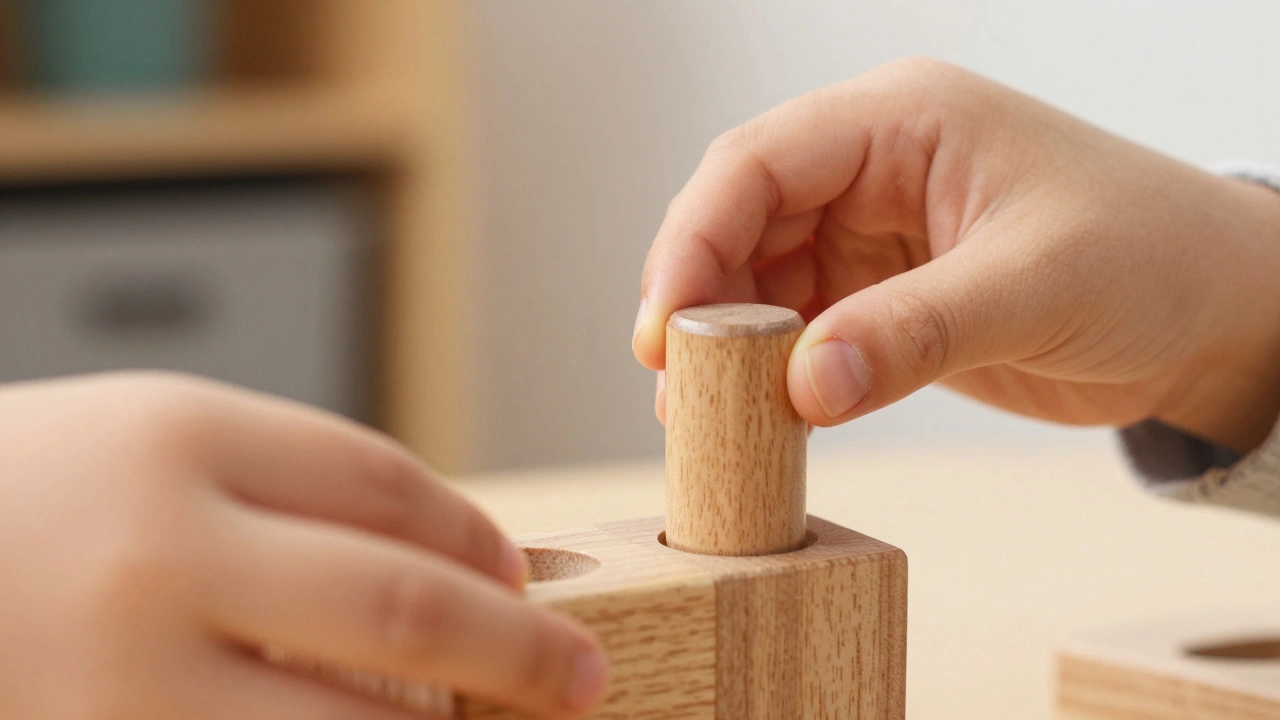
Second, they promote independent learning. This is often achieved through a "control of error." Take the classic cylinder block: if the child puts the large cylinder in the small hole, it simply won't fit. They don't need a parent to say "that's wrong"; the object itself provides the answer. This builds confidence and problem-solving skills without the fear of failure.
| Feature | Montessori Materials | Traditional Toys |
|---|---|---|
| Material | Natural (Wood, Metal, Fabric) | Mostly Plastic |
| Stimulation | Calm, Focused, Singular | High-energy, Flashing, Loud |
| Goal | Mastery of a real-world skill | Entertainment/Distraction |
| Guidance | Self-correcting (Control of Error) | Parent-led or App-guided |
| Purpose | Open-ended exploration | Specific, predetermined play |
Essential Toys by Developmental Stage
You don't need to buy a whole classroom set to get the benefits. The key is matching the material to the child's current "sensitive period"-the window of time where they are most primed to learn a specific skill.
Infants and Early Toddlers (0-18 Months)
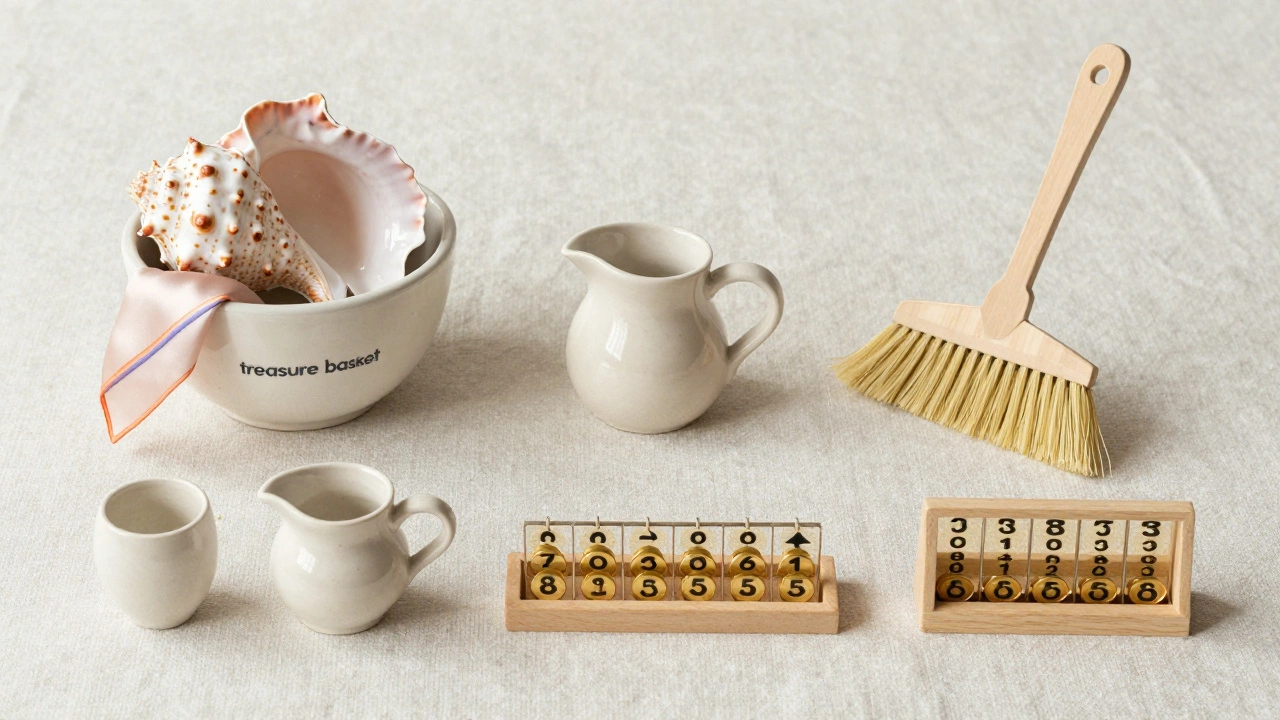
At this stage, it's all about sensory integration. Start with a wooden rattle or a high-contrast mirror. A "treasure basket" filled with everyday objects-a large seashell, a silk scarf, a wooden spoon-is a perfect Montessori starter. These aren't "toys" in the commercial sense, but they teach the baby about the physical properties of the world.
Toddlers (18 Months - 3 Years)
This is the era of "I can do it myself." Focus on practical life skills. Think of small pitchers for pouring water, a child-sized broom, or a dressing frame with buttons and zippers. For cognitive growth, introducing object permanence boxes helps them understand that things still exist even when they can't see them.
Preschoolers (3-6 Years)
Now, we move toward abstraction. This is where the Golden Beads come in-a way to visualize the decimal system by actually holding ten units, a ten-bar, and a hundred-square. Puzzles that require precise fitting or sorting beads by color and size help refine their fine motor skills and visual discrimination.
Common Pitfalls to Avoid
One of the biggest mistakes parents make is buying "Montessori-style" toys but keeping them in a giant, overflowing toy box. If a child has to dig through fifty items to find the one they want, they get overwhelmed and lose focus. The Montessori way is to display items on low, open shelves, with only 6-10 options available at a time. This encourages the child to make a conscious choice and complete one activity before moving to the next.
Another trap is the "helicopter's urge" to help. When you see your child struggling with a wooden puzzle, the instinct is to show them where the piece goes. Resist it. The magic of these toys is in the struggle. When they figure it out themselves, the hit of dopamine and the sense of accomplishment are far more powerful than the praise they would get from a parent.
Integrating Montessori Toys into a Modern Home
You don't have to turn your living room into a sterile lab. You can blend these principles with your existing setup. Start by rotating toys every few weeks. Keep a few in a closet and only put a few on the shelf. This keeps the child's interest high and prevents the "toy fatigue" that happens when everything is always available.
also, remember that the best Montessori toy is often not a toy at all. A bowl of legumes and a pair of tongs for sorting is a high-level motor skill activity. Slicing a banana with a dull, safe knife is a lesson in coordination and independence. The goal is to bridge the gap between play and real life.
Are Montessori toys more expensive than regular toys?
Not necessarily. While high-end wooden sets can be pricey, the core of the philosophy is about simplicity and realism. Many Montessori "toys" are actually household items like measuring cups, sponges, and sorting trays. You can often find sustainable wooden alternatives that are similarly priced to high-end plastic toys, and they tend to last much longer because they aren't prone to breaking or becoming electronically obsolete.
Do I need to be a certified teacher to use these toys?
Absolutely not. While teachers are trained in specific sequences, any parent can apply the basic principles: provide natural materials, limit the number of choices, and allow the child to lead the activity. The most important part isn't the specific toy, but your role as an observer who supports the child's autonomy rather than directing it.
Can Montessori toys replace traditional imaginative play?
Montessori focuses heavily on "real-world" play because young children are deeply interested in what adults actually do. However, this doesn't mean they can't imagine. Many open-ended Montessori materials, like simple blocks or silks, actually fuel a higher level of creativity because they don't dictate what the child should imagine (unlike a toy that only "acts" like a fire truck). They provide the foundation of reality from which imagination can grow.
What is the "Control of Error" in simple terms?
It's essentially a built-in feedback loop. Imagine a puzzle where only one piece fits in one spot. If the child tries to force a piece into the wrong hole, the piece simply won't stay or fit. The child realizes the mistake through the physical properties of the toy, not because a person told them they were wrong. This removes the feeling of failure and replaces it with a puzzle to be solved.
How do I know when to introduce a new toy?
Watch for "repetition cycles." When a child starts doing the same thing over and over-like pouring water from one cup to another for an hour-they are mastering a skill. Once they seem bored or the activity becomes too easy, that's your cue to introduce a slight challenge. If they've mastered pouring water, introduce a smaller pitcher or a funnel to add a new layer of complexity.
Next Steps for Your Home
If you're feeling overwhelmed, don't go out and buy a 20-piece set of cylinders tomorrow. Start with a "toy purge." Clear out the loud, battery-operated distractions and see how your child reacts to a few simple, open-ended objects. Observe which materials they gravitate toward-do they love sorting, stacking, or mimicking your chores? Let their natural interests guide your next purchase or DIY project.