Baby Gate Safety Checker
Is Your Gate Baby-Safe?
This tool helps you determine if your current gate meets UK/EU safety standards for babies. Based on ASTM F1004 and EN 1930 requirements.
Enter your gate details above and click Check Safety
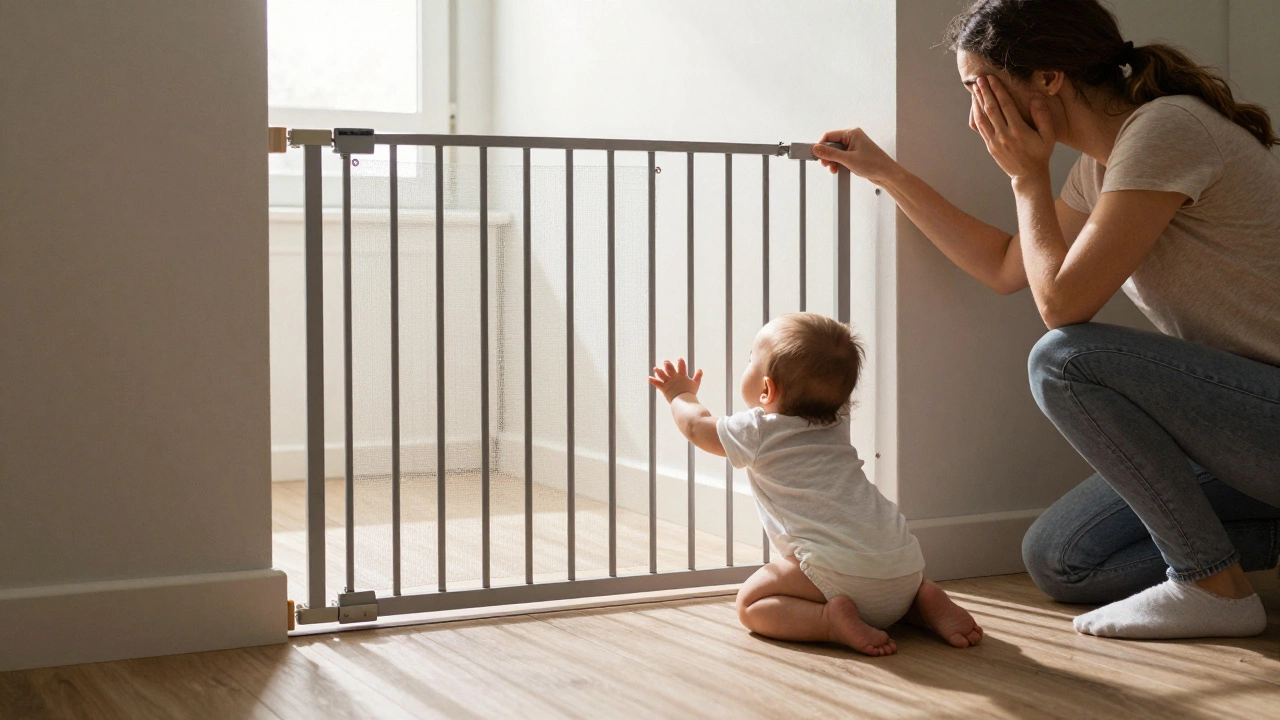
You’ve got a puppy that keeps darting into the kitchen, and a crawling baby who’s about to explore every corner of the house. You’re tempted to grab that sturdy dog gate you bought last year and use it for your child. After all, it’s tall, it’s strong, and it’s already installed. But is it safe? The short answer: dog gates are not designed for babies, and using one as a baby gate can put your child at serious risk.
Why Dog Gates and Baby Gates Are Not the Same
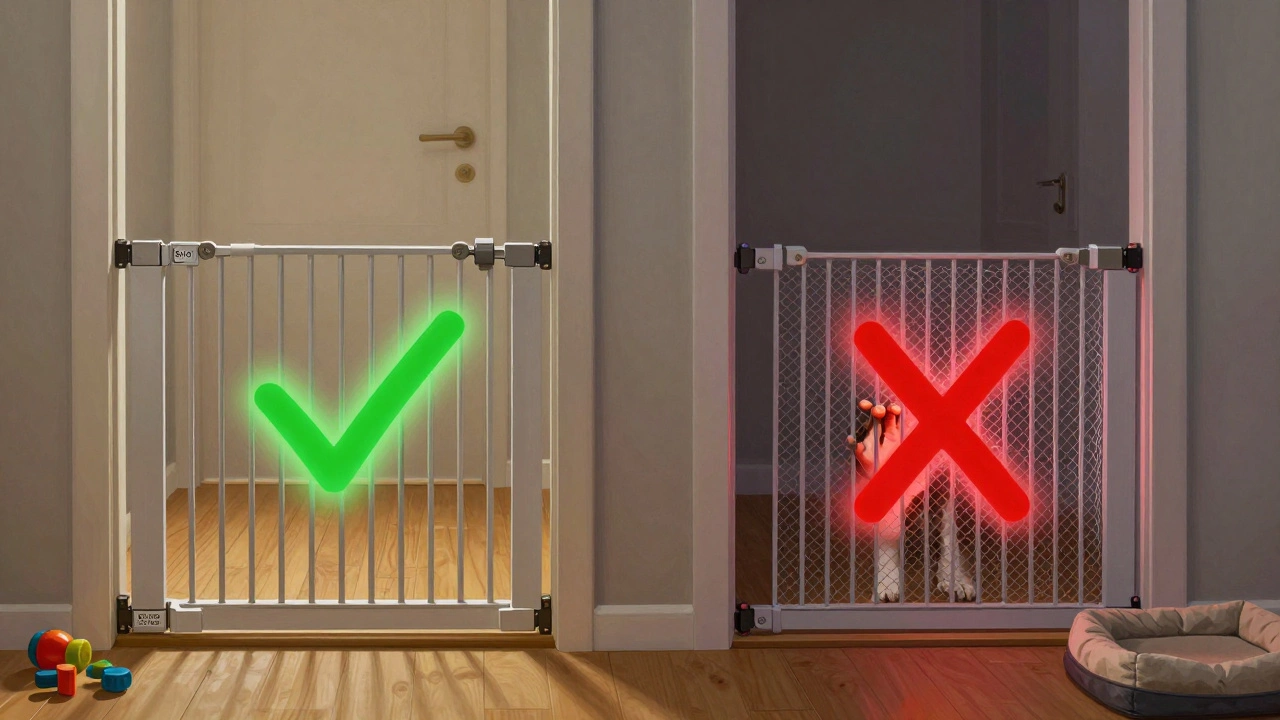
Dog gates and baby gates might look similar-both are barriers you install in doorways-but they’re built for completely different purposes. A dog gate is designed to keep a pet contained. A baby gate is engineered to protect a human child from falls, pinches, and dangerous areas.Think of it this way: a dog might jump, scratch, or push against a gate. A baby doesn’t have the strength to do that. But a baby has other risks: they pull, climb, and fall. They don’t understand boundaries. They test things with their whole body.
Baby gates must meet strict safety standards like ASTM F1004 and EN 1930 in the UK and EU. These standards test for:
- Gap sizes (to prevent head or limb entrapment)
- Material strength under impact
- Auto-close and self-latching mechanisms
- Non-toxic finishes and lack of small parts
Dog gates? They don’t need to meet any of these. Many are made with wider slats, plastic or metal mesh that can pinch fingers, or hardware that doesn’t lock securely under a child’s weight.
Real Risks of Using a Dog Gate for a Baby
Here’s what can go wrong when you use a pet gate as a baby gate:
- Head or neck entrapment: Dog gates often have vertical slats spaced more than 2.5 inches apart. That’s big enough for a baby’s head to slip through. In 2023, the UK’s Child Accident Prevention Trust reported 147 cases of head entrapment in children under two-many linked to non-compliant barriers.
- Pinched fingers: Many dog gates use tension-based mesh or thin wire that can snap shut when a child pushes against it. Babies have tiny fingers. One misstep, and you’re rushing to the ER.
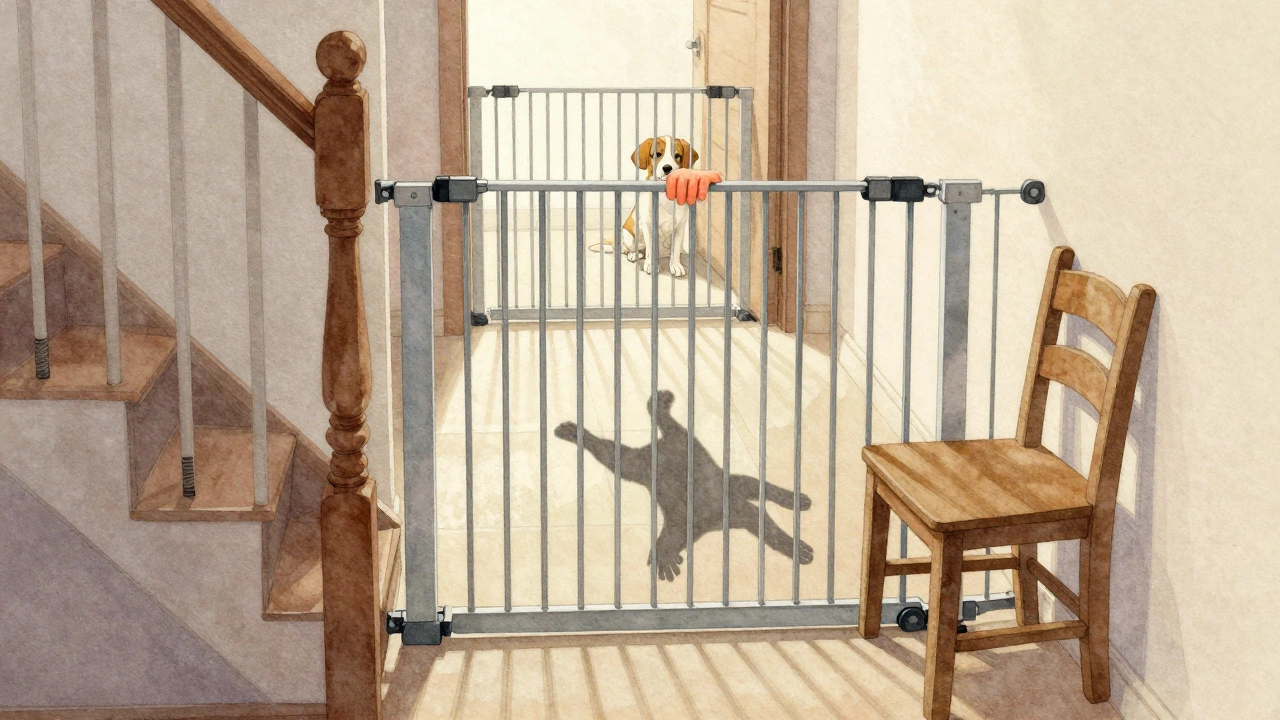
- Gate failure under pressure: Babies climb. They use furniture to pull up. If your dog gate is pressure-mounted and your child uses a nearby chair to scale it, the gate can pop open. No latch. No warning. Just a fall down the stairs.
- Sharp edges or toxic coatings: Pet gates aren’t required to be lead-free or phthalate-free. Babies put everything in their mouths. Even if the gate looks clean, the paint or plastic could contain harmful chemicals.
One mother in Bristol shared her story with a local parenting group: her 11-month-old got stuck between the slats of a dog gate she’d installed at the top of the stairs. She had to call the fire service to cut it open. Her child was fine-but she didn’t sleep for a week after.
What Makes a Baby Gate Safe?
If you’re shopping for a baby gate, here’s what to look for:
- Hardware-mounted, not pressure-mounted: Especially at the top of stairs. Pressure gates can give way. Hardware-mounted gates screw into the wall and won’t budge.
- Slats no wider than 2.2 inches: This is the EU safety standard. Anything bigger is a risk.
- One-handed operation with auto-latch: You need to be able to open it quickly with one hand while holding a baby or a bottle.
- No horizontal bars or steps: These are climbing aids. Babies will use them like a ladder.
- Certified to EN 1930 or ASTM F1004: Look for the mark on the packaging or product label.
Some top-rated baby gates in 2025 include the Summer Infant Multi-Use Deco Gate, the Regalo Easy Step Gate, and the Baby Dan Door Lock Plus. All meet UK/EU safety standards and have been tested for impact, climb resistance, and latch reliability.
What If You’re on a Budget?
Not everyone can afford a new baby gate. If you’re tight on cash, here’s what to do:
- Don’t use a dog gate. No exceptions.
- Check local charities: In Bristol, organizations like Baby Bank Bristol and Parenting Support Network give out free or low-cost safety gates to families in need.
- Look for secondhand baby gates: Ask friends, join local Facebook groups like Bristol Parents Swap, or check charity shops. Just make sure the gate has no broken parts, missing screws, or worn latches.
- Use a door lock: If you can’t install a gate right away, lock the door to dangerous areas (stairs, kitchen, bathroom) with a childproof door lock. It’s not ideal, but it’s safer than a dog gate.
Can You Modify a Dog Gate to Make It Safe?
No. You can’t. Adding fabric, padding, or extra screws won’t fix the core problems:
- You can’t reduce the gap size without replacing the entire frame.
- You can’t make a pressure-mounted gate secure enough for stairs.
- You can’t guarantee the materials are non-toxic.
Trying to modify a dog gate creates a false sense of security. It’s like using a bicycle helmet as a football helmet-same shape, totally different protection.
When Is It Okay to Use a Dog Gate?
Dog gates are perfectly fine-for dogs. Use them to:
- Keep your pup out of the laundry room
- Block off the dining area during meals
- Contain your pet in one room while you work
Just make sure they’re not near stairs, and never within reach of your child. Keep them separate. Use one for your dog, another for your baby.
Final Thought: Safety Isn’t a Shortcut
You’re not saving time or money by reusing a dog gate. You’re risking your child’s safety. Babies don’t have the strength to break a gate. But they don’t need to. All they need is a small gap, a loose latch, or a slippery surface to turn a moment of curiosity into a life-changing accident.
Invest in a proper baby gate. It’s one of the cheapest, most effective safety tools you’ll buy. And if you’re struggling to afford one, reach out. There are people in Bristol who want to help you keep your child safe-no questions asked.
Can I use a dog gate for my baby if I supervise them?
No. Supervision doesn’t eliminate the risks. Babies move fast, and accidents happen in seconds. A gate that looks sturdy to you might still have gaps, pinch points, or weak latches that a child can exploit. Safety gates are designed to work even when you’re not watching.
Are there any dog gates that are safe for babies?
There are no dog gates certified as safe for babies. Even if a dog gate looks similar to a baby gate, it hasn’t been tested for child safety standards like EN 1930 or ASTM F1004. Never assume a product is safe just because it’s sturdy.
What’s the difference between pressure-mounted and hardware-mounted baby gates?
Pressure-mounted gates use tension to stay in place and are only safe for doorways, not stairs. Hardware-mounted gates are screwed into the wall and are the only type approved for the top of stairs. If you’re blocking off stairs, hardware mounting is non-negotiable.
How do I know if my baby gate is certified?
Look for the EN 1930 or ASTM F1004 mark on the packaging or the gate itself. If you can’t find it, contact the manufacturer. If they can’t provide proof of certification, don’t use it. Safety standards aren’t optional-they’re life-saving.
Where can I get a free baby gate in Bristol?
Contact Baby Bank Bristol, Parenting Support Network, or your local health visitor. Many charities provide free safety equipment to families on low income or with multiple children. You don’t need to prove hardship-just ask.
Next Steps: What to Do Today
- If you’re currently using a dog gate for your baby: remove it immediately.
- Check your stairs. If you don’t have a hardware-mounted gate at the top, install one before your child starts pulling up.
- Call a local parenting charity in Bristol. Ask if they have a gate you can borrow or buy at cost.
- When shopping, read the label. If it doesn’t say EN 1930 or ASTM F1004, leave it on the shelf.
Your child doesn’t need the fanciest gate. They just need a safe one. Don’t gamble with their safety. Use the right tool for the job.