

Educational Kit Finder
Find Your Perfect Kit
Learning Outcomes
Select age and interest to see learning outcomes
Recommended Kits
Ever seen a box of colorful blocks, gears, or circuit pieces labeled as an "educational kit" and wondered what it actually does? It’s not just another toy. An educational kit is a carefully designed set of materials that helps kids learn by doing - whether they’re building a robot, coding a simple game, or exploring how plants grow. These kits turn playtime into real learning, and they’re becoming a go-to tool for parents who want their kids to grow curious, confident, and capable.
What Makes an Educational Kit Different?
Not all toys that claim to be "educational" actually teach anything meaningful. A typical educational kit stands out because it’s built around a clear learning goal. It doesn’t just entertain - it guides. Most kits include step-by-step instructions, hands-on components, and challenges that get harder as the child progresses. Think of it like a mini science lab or a programming workshop, but designed for a 5-year-old or a 12-year-old, depending on the kit.
For example, a basic early-learning kit might have wooden letters, sound cards, and a storybook to help toddlers connect sounds with symbols. A more advanced one might include solar panels, motors, and wires so a 9-year-old can build a working windmill. The key difference? Every piece has a purpose. There’s no fluff. No random stickers or gimmicks. Just tools that help kids understand how things work.
How Do Educational Kits Help Kids Learn?
Research from the University of California, Berkeley shows that kids who learn through hands-on activities retain information 70% longer than those who just listen or read. That’s because doing something - like wiring a circuit or sorting gears by size - activates more parts of the brain than watching a video or being told how something works.
Here’s what kids actually gain from using these kits:
- Problem-solving skills: When a tower falls or a robot won’t move, they don’t give up. They test, adjust, try again.
- Logical thinking: Coding kits teach sequencing. Math kits show how numbers relate to real shapes and measurements.
- Confidence: Completing a project - even a small one - gives kids a sense of "I made this." That feeling sticks.
- Curiosity: Once a child builds a simple battery-powered car, they start asking: "What if I make it faster? What if I add wheels?"
These aren’t just "soft skills." They’re the foundation for future success in school, careers, and life. And unlike screen time, which often passesively entertains, educational kits demand active participation.
Types of Educational Kits Available Today
There’s no single kind of educational kit. The market has exploded with options tailored to different ages, interests, and learning styles. Here are the most common types you’ll find right now:
- STEM kits: Focus on science, technology, engineering, and math. Examples: robotics kits with programmable motors, chemistry sets with safe reagents, or engineering kits with pulleys and levers.
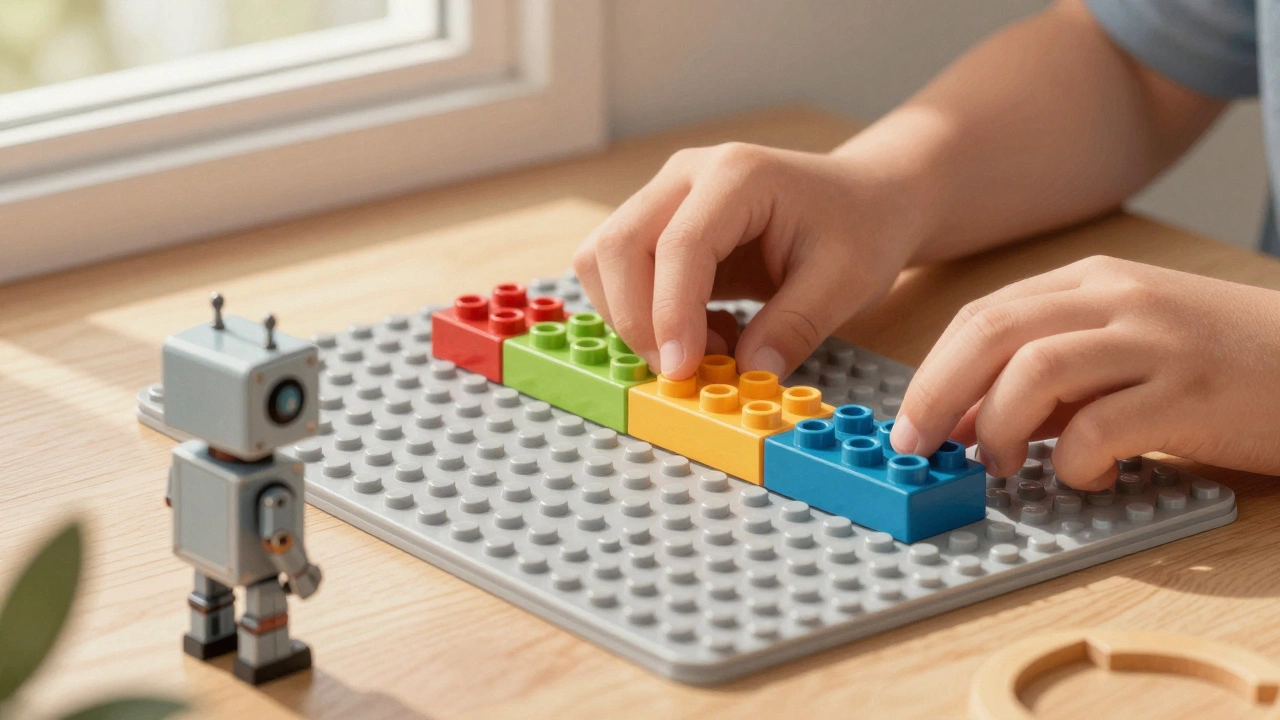
- Coding kits: Teach logic and computational thinking without screens. Some use physical blocks that snap together to create commands; others come with simple apps that guide kids through coding challenges.
- Art and design kits: Combine creativity with structure. Think: 3D puzzle art, geometric pattern tiles, or DIY jewelry-making kits that teach symmetry and measurement.
- Early learning kits: For toddlers and preschoolers. These focus on colors, shapes, letters, numbers, and fine motor skills. Often include tactile cards, sorting trays, and sound buttons.
- Nature and science kits: Grow plants from seeds, observe insects under magnifiers, or build weather stations. These encourage outdoor exploration and observation.
Many of these kits now come with companion apps or QR codes that unlock video tutorials - but the core learning still happens through touch, trial, and error.
What to Look for When Choosing a Kit
Not every kit lives up to its promise. Some are overpriced, under-designed, or too complicated. Here’s what to check before buying:
- Age range: Make sure it matches your child’s skill level. A kit meant for ages 8+ might have tiny parts or complex instructions that frustrate a 5-year-old.
- Clear learning goals: The packaging should say what they’ll learn - not just "fun and educational." Look for phrases like "teaches basic circuitry" or "introduces fractions through play."
- Reusability: Can the pieces be used in other projects? High-quality kits use durable, interchangeable parts that can be rebuilt into new designs.
- Parent involvement: Some kits require adult help. That’s fine - but only if the instructions are clear and don’t demand a degree in engineering.
- Safety: All kits should be ASTM or CE certified. Avoid anything with small magnets or sharp edges unless it’s clearly labeled for older kids.
Brands like KiwiCo, littleBits, and Thames & Kosmos consistently rank high in parent reviews for balancing fun, learning, and durability. But don’t overlook local makers or open-source kits - many are just as good and cost less.
Real-Life Examples: What Do These Kits Actually Do?
Let’s say you buy a coding kit for ages 6-9. It comes with 12 color-coded blocks, each representing a command: "move forward," "turn left," "repeat." Your child snaps them together like puzzle pieces to make a robot walk in a square. No screen. No typing. Just logic in their hands.
Or take a plant science kit. It includes soil, seeds, a measuring cup, a journal, and a growth chart. Over four weeks, your child waters, measures, and draws the plant’s progress. By the end, they’ve learned about photosynthesis, measurement, patience, and responsibility - all without a textbook.
One parent in Ohio shared that her 7-year-old, who refused to do math homework, became obsessed with a math-based puzzle kit that turned equations into treasure hunts. Within three months, he was solving two-digit addition problems for fun.
These aren’t rare stories. They’re common outcomes when learning is tied to doing.

Where Do Educational Kits Fit in Everyday Life?
They’re not meant to replace school. They’re meant to complement it. Think of them as weekend experiments, rainy-day projects, or after-dinner challenges. Many families use them as part of a weekly "learning hour" - no screens, no TV, just hands-on exploration.
They also work well for siblings. A 10-year-old can guide a 6-year-old through a simple circuit, building teamwork along the way. Or they can be used in homeschooling setups, where structured play replaces traditional worksheets.
And here’s the quiet win: these kits often spark conversations. "How does this work?" "Why did it break?" "What if we tried this?" That’s the real magic. The learning doesn’t stop when the kit is put away.
Common Misconceptions
Let’s clear up a few myths:
- Myth: You need to be tech-savvy to use these kits.
Truth: Most kits are designed for parents who know nothing about coding or electronics. Instructions are visual, simple, and step-by-step. - Myth: They’re too expensive.
Truth: Basic kits start under $25. Even advanced ones rarely cost more than $80 - less than a single video game. - Myth: They’re only for "gifted" kids.
Truth: They’re for every kid. Some learn faster. Others take longer. That’s okay. The goal isn’t perfection - it’s curiosity.
These kits aren’t about creating future engineers. They’re about creating future thinkers.
Final Thought: More Than a Toy
An educational kit is more than a box of parts. It’s a doorway. A way for kids to ask questions, test answers, and discover that learning doesn’t have to be boring. It can be messy. It can be loud. It can be fun.
And that’s why, year after year, parents keep choosing them. Not because they’re trendy. But because they work.
Are educational kits worth the money?
Yes - if you choose one that matches your child’s age and interests. A good kit lasts for months or even years as kids revisit projects. Many parents say they’ve used the same kit with multiple children. Compared to a single-use toy or video game, the long-term learning value is much higher.
Can a 3-year-old use an educational kit?
Absolutely - but only if it’s designed for toddlers. Look for kits labeled "ages 3+" with large pieces, no small parts, and simple tasks like matching colors, sorting shapes, or stacking blocks. Avoid anything with electronics or complex instructions. The goal at this age is sensory exploration, not problem-solving.
Do educational kits replace school learning?
No. They complement it. School teaches structure, facts, and group learning. Educational kits teach curiosity, trial-and-error, and independent thinking. Together, they give kids a fuller picture of how to learn - not just what to learn.
What’s the best educational kit for a child who loves robots?
For ages 6-10, the LEGO Education SPIKE Essential kit is a top choice. It uses simple drag-and-drop coding to make robots move, turn, and respond to sensors. For older kids (11+), the Makeblock mBot Ranger offers more advanced programming and real-world challenges like obstacle avoidance. Both are used in schools worldwide.
How long should a child spend with an educational kit each day?
There’s no rule. Some kids spend 20 minutes. Others get lost in it for an hour. Let them lead. The goal isn’t to clock time - it’s to keep the curiosity alive. Even 10 minutes of focused play several times a week is more valuable than an hour of distracted screen time.