
Baby Weight Checker
Check Your Baby's Weight Range
Enter your baby's weight to see where they fall on the CDC growth chart. Remember: consistent growth patterns matter more than a single number.
Important note: This is a reference tool only. Growth patterns matter more than single measurements. Discuss concerns with your pediatrician.
When your baby turns three months old, you might find yourself staring at the scale, wondering if they’re growing right. Is 12 pounds enough? Is 16 pounds too much? The truth is, there’s no single number that says "perfect." But there are clear, science-backed ranges that tell you if your baby is on track - and when to talk to a doctor.
What’s Normal for a 3-Month-Old Baby?
At three months, most babies have gained about 1.5 to 2 pounds per month since birth. That means if your baby weighed 7 pounds at birth, they’re likely between 11 and 13 pounds now. But that’s just an average. Healthy babies can weigh anywhere from 9.5 to 17 pounds at this age and still be perfectly fine.
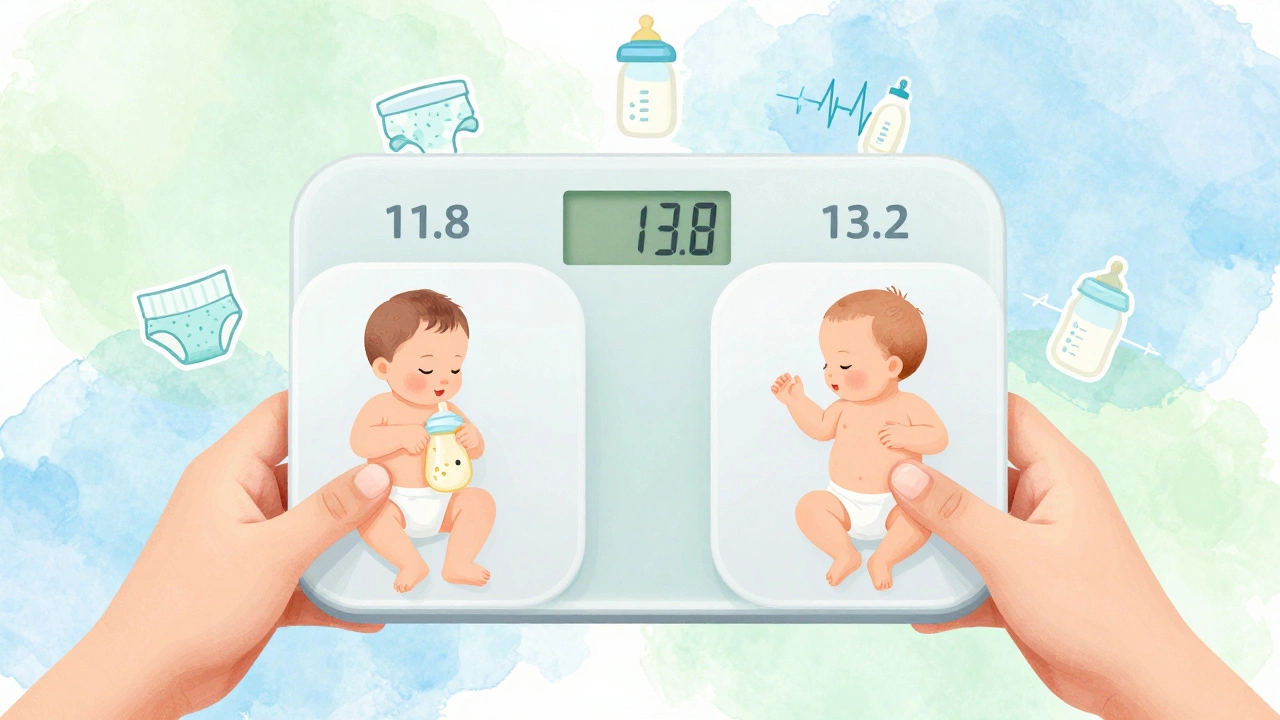
The CDC growth charts show that the 50th percentile for weight at 3 months is about 12.8 pounds for boys and 11.8 pounds for girls. But the 5th percentile? Around 9.5 pounds. The 95th? Up to 17 pounds. That’s a wide range - and it’s all normal.
What matters more than the number on the scale is the pattern. Did your baby lose weight after birth? Most do - up to 10% - and then start gaining steadily. By 2 weeks, they should be back to birth weight. By 3 months, they should be climbing steadily along their own curve.
Why Weight Gain Matters More Than the Number
A baby who weighs 14 pounds at 3 months isn’t "better" than one who weighs 11. What matters is whether they’re gaining consistently. If your baby’s weight has stayed flat for two weeks or dropped off their usual curve, that’s a red flag. If they’re zooming up past the 95th percentile, that’s worth checking too.
Doctors track growth using percentiles, not absolute numbers. Think of it like a road map. Your baby is driving their own car, not racing against others. As long as they’re staying on their lane - even if it’s the 10th or 85th percentile - they’re doing fine.
Signs your baby is growing well:
- Wets 6 to 8 diapers a day
- Has regular, soft bowel movements
- Seems satisfied after feeds
- Is alert, responsive, and has good eye contact
- Is gaining weight at a steady pace (about 1.5 to 2 pounds per month)
If your baby’s gaining weight slowly but still hits these marks, they’re probably fine. If they’re not gaining at all - or losing weight - it’s time to talk to your pediatrician.
How Breastfed and Formula-Fed Babies Differ
Breastfed babies often gain weight faster in the first month, then slow down a bit after 2 months. Formula-fed babies tend to gain weight a little faster overall, especially after 2 months. That’s because formula is more calorie-dense and digested differently.
A 2023 study in Acta Paediatrica tracked over 10,000 infants and found that by 3 months, formula-fed babies weighed about 0.5 to 1 pound more on average than breastfed babies. But both groups were healthy. The key difference? Breastfed babies often had leaner body composition - meaning more muscle, less fat.
Don’t assume your baby needs more formula just because they’re smaller. Breast milk changes composition as your baby grows. It’s designed to match their needs - not to make them bigger, but to make them stronger.
When to Worry About Weight
Most parents panic when their baby doesn’t hit the "average." But here’s what actually needs attention:
- Weight loss after the first two weeks
- Not gaining any weight for 2 weeks or more
- Feeding less than 6 times a day (or not nursing for more than 4 hours at a stretch)
- Extreme sleepiness, weak cry, or floppy muscle tone
- Diapers stay dry for more than 8 hours
If your baby is eating well, smiling, and making steady progress, don’t stress over the scale. But if you see any of the red flags above - call your doctor. Early intervention makes all the difference.
What If My Baby Is Too Heavy?
Some babies are big. Really big. And that’s okay - unless it’s sudden or tied to other issues. A baby who’s consistently above the 95th percentile might need a closer look. Why? Because rapid weight gain in the first few months can increase the risk of childhood obesity later.
But here’s the catch: it’s rarely about overfeeding. More often, it’s about:
- Too much formula (oversized bottles, forcing feeds)
- Adding cereal to bottles (not recommended before 4 months)
- Genetics (big parents often have big babies)
- Underlying conditions like hormonal imbalances (rare)
If your baby is big but happy, active, and growing steadily, they’re likely just genetically predisposed to be larger. Your pediatrician can help you track their body mass index (BMI) after 2 years - not before.
Never cut back on feeds to "make them lose weight." Babies need calories to grow brains, bones, and immune systems. Restricting food can cause serious developmental delays.

How Often Should You Weigh Your Baby?
At 3 months, your baby should be weighed at their well-baby checkup - usually at 2 weeks, 2 months, and 4 months. That’s it. You don’t need to weigh them weekly.
Home scales are inaccurate. Babies wiggle. Scales aren’t calibrated. A 0.5-pound swing might just be a wet diaper or a full tummy. Trust your pediatrician’s scale - and your own eyes.
Watch how your baby looks and acts. Are they filling out their clothes? Do their cheeks look plump? Are they reaching for toys, cooing, and tracking movement? Those are better indicators than a number.
What Comes Next After 3 Months?
By 4 months, your baby will start gaining weight a little slower - about 1 to 1.5 pounds per month. At 6 months, they’ll likely double their birth weight. By 1 year, most triple it.
Around 6 months, solid foods start. That’s when weight gain patterns shift again. But until then, breast milk or formula is all they need. Don’t rush solids just to make them gain faster.
Every baby grows differently. One might shoot up in height first. Another might bulk up in weight. Both are normal. Growth isn’t a race. It’s a quiet, steady journey - and your baby is doing exactly what they’re supposed to do.
Final Thought: Trust Your Baby, Not the Chart
The charts are tools - not rules. They help doctors spot problems. They don’t define health. If your baby is happy, alert, feeding well, and growing along their own path, they’re thriving.
Compare your baby to others at your own risk. One baby might be 10 pounds and crawling. Another might be 16 pounds and still working on head control. Both are normal. Growth isn’t about size - it’s about progress.
So next time you step on the scale, ask yourself: Is my baby healthy? Are they smiling? Are they meeting milestones? If yes - you’re already doing better than most parents realize.