Mental Development Toy Checker
Check if your toy promotes real mental growth or is just another passive entertainment option.
Evaluate Your Toy
Answer these questions about your toy to see if it supports healthy cognitive development.
Every parent wants their child to grow up smart, curious, and confident. But how do you actually help with that? It’s not about flashcards or early math drills. The real secret? play. Specifically, the right kind of play - the kind that challenges their thinking, sparks curiosity, and builds real mental muscles. Not all toys do this. Some just light up and make noise. Others actually change how a child learns to solve problems, understand cause and effect, and think creatively. So what toys actually work? Let’s cut through the hype and look at what science and real-world experience show.
Building Blocks: More Than Just Stacking
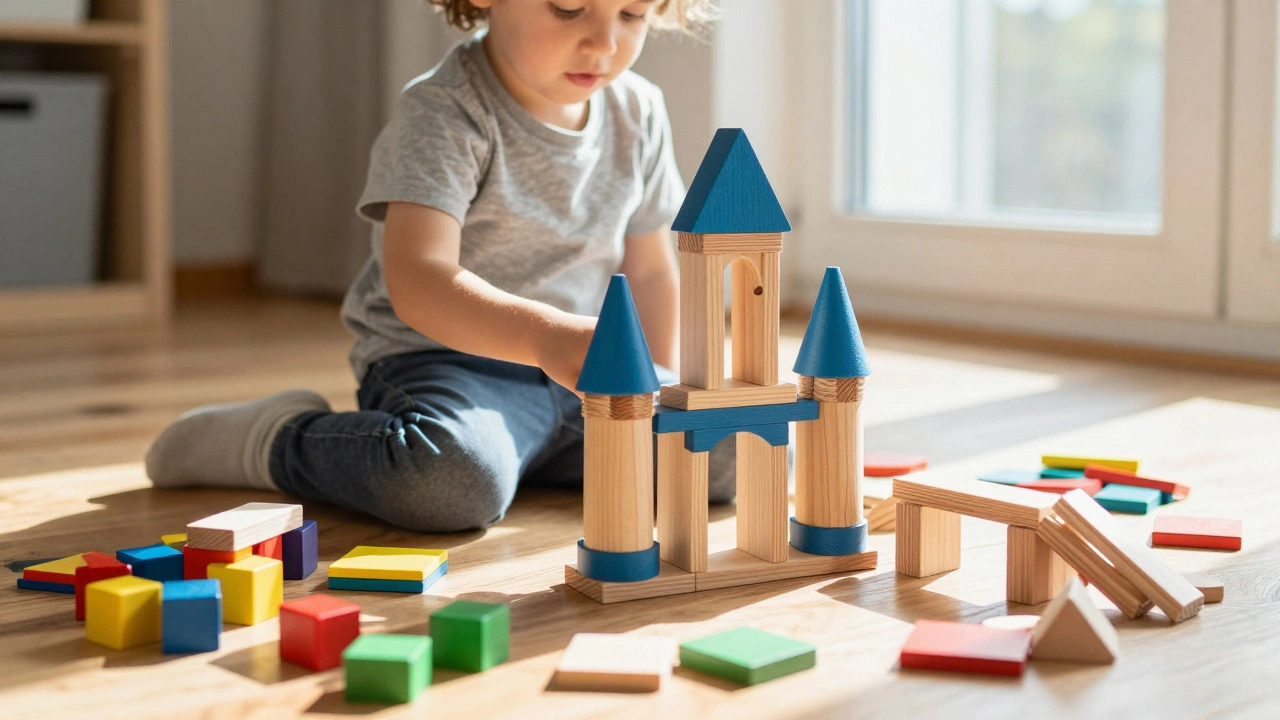
Legos, wooden blocks, magnetic tiles - these aren’t just toys. They’re tiny engineering labs. When a toddler stacks a block tower and it falls, they’re not just frustrated. They’re learning gravity, balance, and spatial reasoning. By age three, kids who play regularly with blocks score higher on tests measuring spatial skills - a key predictor of future success in math and science. A 2023 study from the University of Cambridge tracked 120 children over two years and found those who played with open-ended blocks for at least 15 minutes a day showed 27% better problem-solving scores than peers who didn’t. Why? Because blocks don’t have one right answer. You can build a castle, a bridge, or a spaceship. Each attempt teaches trial, error, and adaptation.
Puzzles: The Silent Problem-Solvers
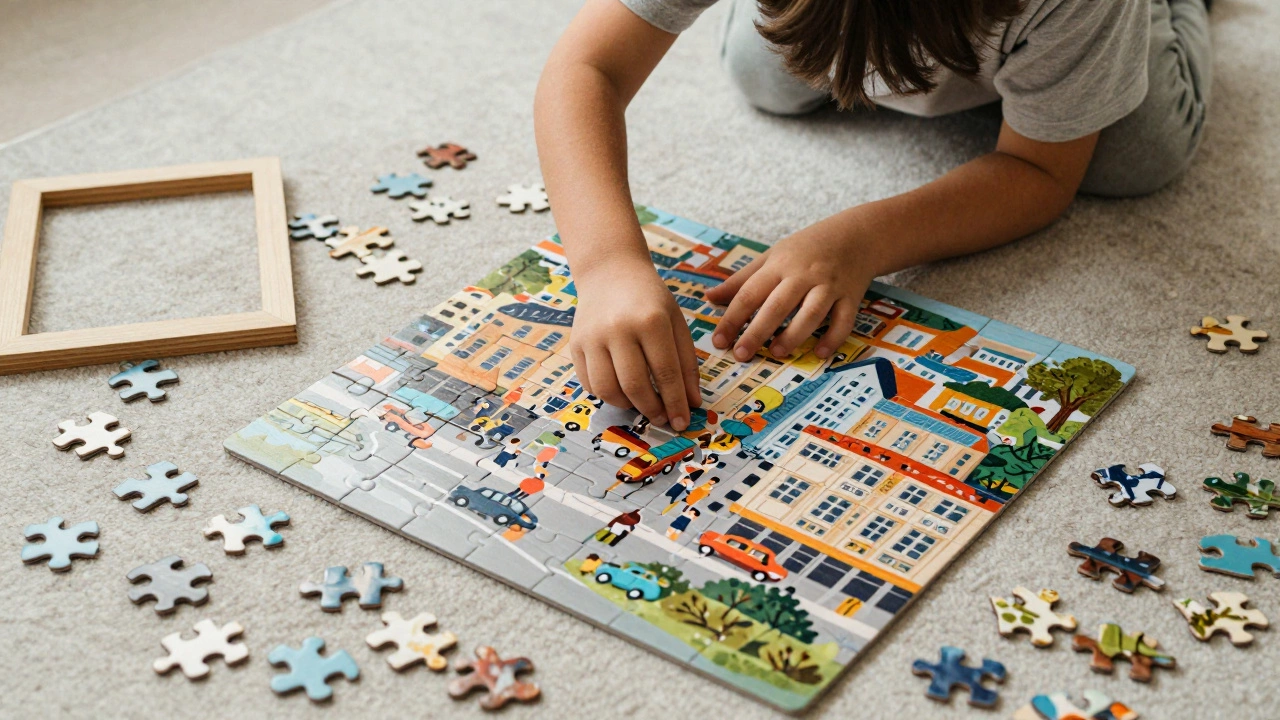
Puzzles are the quiet champions of mental growth. A simple 12-piece jigsaw isn’t just about fitting shapes. It’s about pattern recognition, memory, hand-eye coordination, and patience. Start with chunky wooden puzzles for toddlers - the kind with big knobs. By age 3, move to 24-48 piece puzzles with real-world images like animals, vehicles, or city scenes. Around age 5, introduce 3D puzzles or logic mazes. These aren’t just fun - they train working memory. Kids have to remember what pieces they’ve tried, where they fit, and what’s left. A 2024 study from the University of Edinburgh showed children who solved puzzles three times a week for six months improved their short-term memory by 34% compared to those who didn’t. The best puzzles? Ones that don’t come with a picture on the box. Let them figure it out from scratch.
Art Supplies: Creativity as a Skill
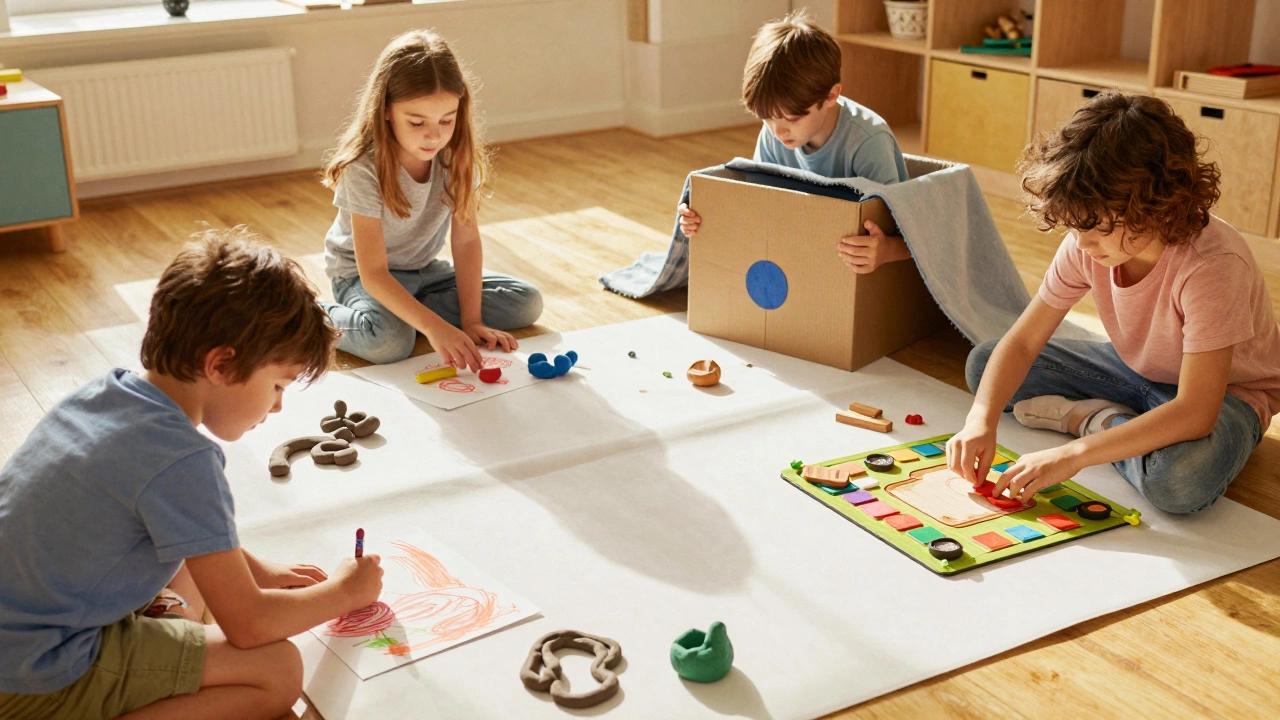
Many parents think art is just about making pretty things. It’s not. Drawing, painting, sculpting with clay - these are active thinking exercises. When a child draws a house, they’re deciding what to include, what to leave out, how to represent a door or a window. That’s abstract thinking. When they mix paints and see blue and yellow turn green, they’re learning cause and effect. Open-ended art tools - washable crayons, non-toxic clay, finger paints, recyclable materials - give kids control. No instructions. No right or wrong. Just experimentation. A 2025 report from the National Association for the Education of Young Children found children who engaged in daily free art play had 40% higher scores on creativity tests. The key? Don’t correct. Don’t direct. Just give them the materials and let them explore.
Board Games: Strategy in a Box
Yes, board games. Even for kids under 5. Games like Snakes and Ladders teach counting and turn-taking. Candy Land helps with color recognition and following rules. But the real mental boost comes from games that require decisions. Memory (the matching card game) sharpens recall. Cooperative Games like Hoot Owl Hoot! teach teamwork and planning. For kids 6 and up, try Spot It! for pattern speed or Rush Hour for logic puzzles. These aren’t just entertainment - they’re cognitive workouts. A 2024 study published in the Journal of Child Psychology found that children who played strategy-based board games twice a week for four months improved their executive function scores - including impulse control and planning - by 31%. The best part? They’re playing. They don’t even realize they’re learning.
Science Kits: Little Scientists in the Making
Forget expensive gadgets. Real science starts with simple, hands-on exploration. A basic magnet set, a solar-powered car kit, or a grow-your-own-crystals experiment - these spark questions. Why does the magnet stick? Why does the plant grow toward the light? These aren’t just facts. They’re the beginning of scientific thinking. Kits from brands like Thames & Kosmos or Learning Resources are designed for real experimentation, not just following steps. A child who builds a simple circuit learns about electricity. One who plants seeds learns about life cycles. The key is letting them make mistakes. If the circuit doesn’t work, don’t fix it. Ask: “What do you think went wrong?” That’s how critical thinking grows.
Open-Ended Toys: The Hidden Power of Nothing
Some of the best toys for mental development don’t have batteries, instructions, or buttons. Think of a cardboard box. A blanket. A pile of sticks. These are the ultimate open-ended tools. They force imagination. A box becomes a spaceship. A blanket becomes a castle. A stick becomes a magic wand. This kind of play builds narrative skills, emotional understanding, and flexible thinking. A 2025 longitudinal study from Stanford University tracked 200 children from age 2 to 8. Those who regularly played with open-ended materials showed stronger language development, higher empathy scores, and better adaptability in new situations. Why? Because they had to invent everything. No app told them what to do. They had to think it up themselves.
What to Avoid
Not all toys labeled “educational” are created equal. Steer clear of:
- Toy tablets that promise to teach ABCs with flashing lights - they often replace real interaction
- Single-purpose toys that only do one thing, like a shape sorter with no variation
- Over-stimulating toys with loud noises, flashing lights, and automatic voice prompts
- Products that claim to make your child “genius” or “ahead of the curve” - those are marketing, not science
The best toys don’t teach. They invite. They don’t give answers. They ask questions. They don’t control the play. They let the child lead.
How to Choose
When you’re looking at a toy, ask:
- Does it let the child create, not just consume?
- Can it be used in more than one way?
- Does it encourage problem-solving, not just memorization?
- Does it need batteries? If yes, is it really necessary?
- Will it still be fun in six months?
If the answer to most of these is yes - you’ve got something valuable. A toy doesn’t need to be expensive. A set of wooden blocks, a few crayons, and a pile of cardboard can do more for a child’s brain than a $200 electronic learning tablet.
Are electronic toys good for mental development?
Most electronic toys that play sounds, lights, or pre-recorded lessons don’t build deep thinking. They replace imagination with passive listening. A 2024 study in the journal Child Development found children who played with electronic learning toys spent less time exploring and more time waiting for the next sound. Real mental growth happens when kids are in charge - not when a toy is. Stick to toys that require active problem-solving, not passive watching.
How much time should kids spend with these toys?
There’s no magic number, but aim for at least 30 minutes a day of uninterrupted, child-led play with open-ended toys. Quality matters more than quantity. One focused hour building with blocks is better than three hours of distracted screen time. The key is consistency - not intensity. Regular, daily play builds neural pathways over time.
Can older kids still benefit from these toys?
Absolutely. Building blocks, puzzles, and art supplies don’t lose their value as kids grow. A 10-year-old can build complex structures with magnetic tiles, solve advanced logic puzzles, or use clay to model scientific concepts. The difference? Their questions get deeper. What used to be a tower becomes a skyscraper with elevators. What was a drawing becomes a comic strip with a plot. The toys stay the same - the thinking gets richer.
What if my child doesn’t seem interested?
Try introducing the toy differently. Don’t say, “Here’s a puzzle.” Instead, say, “Look what I found - this piece looks like a dragon’s tail. Can you find where it fits?” Make it part of a story. Play with it yourself first. Kids often mirror what they see. If they think it’s boring, they might just need to see you enjoying it. Also, don’t force it. Sometimes, a toy sits unused for weeks - then suddenly becomes their favorite. Patience matters.
Are expensive toys better than cheap ones?
Not at all. A $50 electronic learning toy is not better than a $10 set of wooden blocks. What matters is how the toy is used, not how much it cost. Open-ended, non-electronic toys - like blocks, art supplies, or simple board games - offer more room for creativity and deeper learning. Many expensive toys are designed to be used once or twice before the child loses interest. The best ones keep evolving with the child.
Final Thought
The goal isn’t to raise a genius. It’s to raise a thinker. A child who asks questions. Who tries again when something breaks. Who imagines what could be. The best toys don’t come with a manual. They come with a challenge: What can you make? What can you discover? That’s where real mental growth begins - not in a classroom, but in the quiet, messy, wonderful space of play.