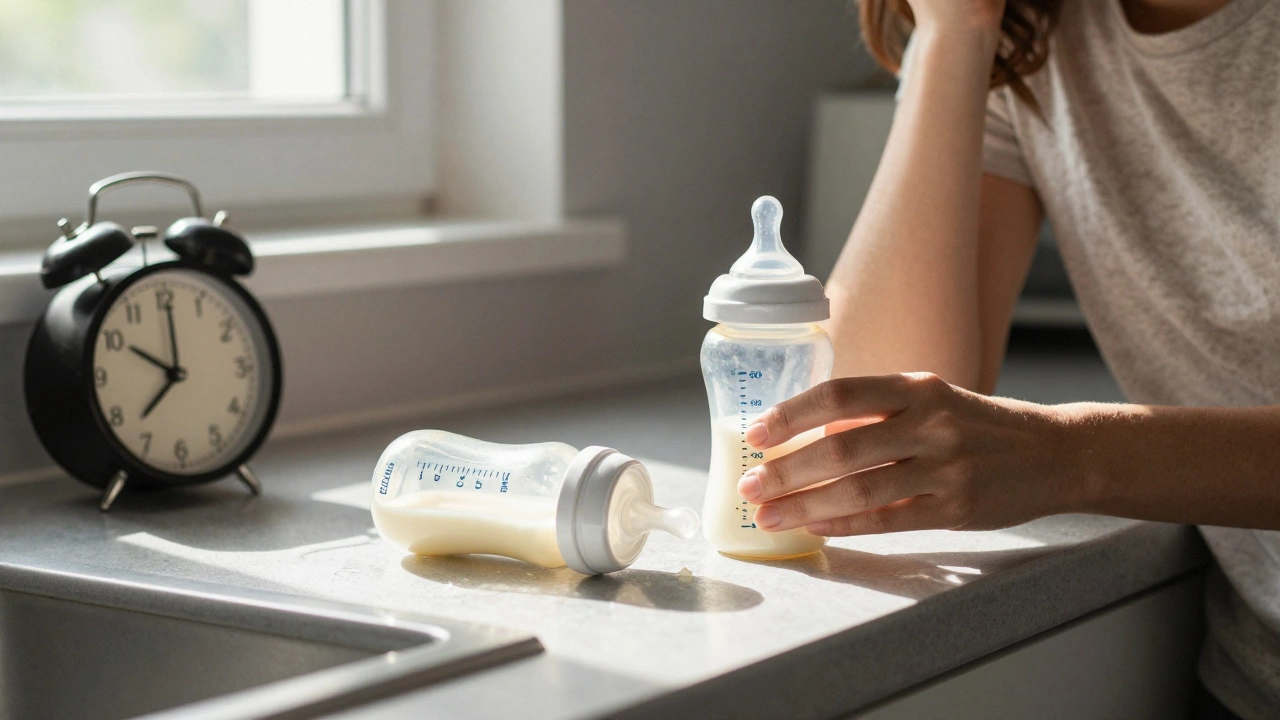
Bottle Safety Timer
Keep Your Baby Safe
Track how long your baby's bottle has been exposed to bacteria. Remember: Once your baby starts drinking, bacteria enters the milk. Discard after 1 hour.
Important: The CDC and AAP recommend discarding any bottle that's been at room temperature for more than one hour, even if you refrigerate it afterward. Bacteria multiply quickly and become dangerous before you can see or smell them.
Leaving a bottle out for more than an hour isn’t just messy-it’s risky. Babies under one year old have immune systems that aren’t fully developed. That means even a little bit of bacteria can turn a harmless leftover bottle into a health threat. You might think, "It’s only been an hour, and the room isn’t that warm," but bacteria don’t wait for permission to multiply. They start growing the moment milk touches air-and they multiply fast.
How quickly does milk go bad in a bottle?
Breast milk and formula begin to support bacterial growth as soon as they’re exposed to the environment. The CDC and the American Academy of Pediatrics both say that prepared formula should be used within one hour of starting a feeding. Breast milk has slightly more leeway-up to two hours at room temperature-but only if it’s freshly expressed and kept in a cool, clean environment. After that, the risk jumps sharply.
Why one hour? Because by then, bacteria from the baby’s mouth have already entered the bottle. Every sip introduces saliva, which carries bacteria like Enterobacter sakazakii and Cronobacter. These aren’t rare bugs-they’re common in household dust, on countertops, and even on the baby’s skin. In healthy adults, they’re harmless. In infants, especially those under three months, they can cause severe infections, including meningitis or sepsis.
There’s no visible sign when milk turns unsafe. It won’t smell sour, change color, or bubble. That’s the danger. You can’t tell by looking. You have to rely on time.
What happens if a baby drinks old milk?
Most of the time, nothing serious happens. Babies are surprisingly resilient. But sometimes, the consequences are severe. In 2021, the FDA reported a cluster of infant infections linked to formula left at room temperature for over two hours. Three babies under six weeks old were hospitalized with fever, vomiting, and lethargy. One developed meningitis. All recovered, but only because they were treated early.
Even if your baby doesn’t get sick, drinking milk that’s been sitting too long can cause upset stomachs, gas, diarrhea, or refusal to feed. Parents often mistake this for a "fussy eater" or "teething phase," when it’s really just spoiled milk.
There’s no safe "maybe" here. If it’s been more than an hour since the baby started drinking, toss it. No exceptions.
Why can’t you just reheat it?
Some parents think reheating kills the danger. It doesn’t. Heating milk to warm it up doesn’t destroy the toxins that bacteria produce. Some of these toxins, like those from Staphylococcus aureus, are heat-stable. That means boiling the bottle won’t make it safe-it just makes hot, dangerous milk.
Also, reheating milk more than once changes its nutritional value. Vitamins break down, proteins denature, and fats oxidize. You’re not just risking infection-you’re giving your baby less nutrition.
And don’t assume that microwaving is safe. Microwaves heat unevenly. You can end up with scalding hot spots that burn the baby’s mouth while the rest of the milk stays cold. The American Academy of Pediatrics specifically warns against microwaving bottles.
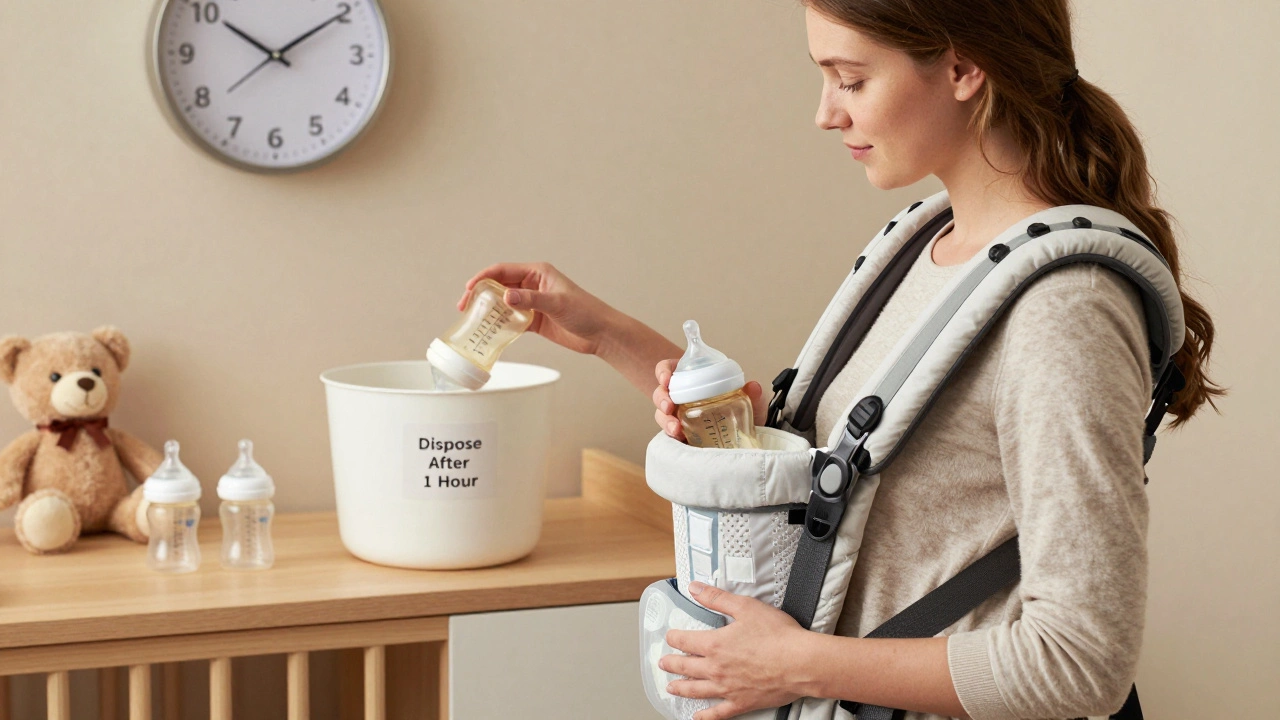
What should you do instead?
Plan ahead. If you’re out and about, bring only what your baby will likely drink in one sitting. A 4-ounce bottle is plenty for most feedings. If you’re unsure, prepare a fresh bottle when needed. Use insulated bottle carriers with ice packs to keep milk cool for up to four hours.
At home, time your feedings. If your baby takes 20 minutes to finish a bottle, start with 3-4 ounces. That way, even if they pause or get distracted, you won’t be left with half a bottle sitting out.
For working parents: If you’re pumping and storing milk for later, label each container with the date and time. Use refrigerated milk within 24 hours. Frozen milk lasts up to six months. Never thaw milk at room temperature-do it in the fridge or under cool running water.
My baby didn’t finish the bottle. Can I save it?
No. Even if your baby only took a sip, the bottle is now contaminated. The CDC’s guidelines are clear: once a bottle has been in contact with the baby’s mouth, it’s no longer safe to store for later use.
That includes bottles you’ve warmed and then set aside. If your baby doesn’t drink it within an hour, throw it away. It’s not wasteful-it’s protective.
Some parents try to stretch usage by refrigerating leftovers. That’s a myth. Refrigeration slows bacteria, but doesn’t stop it. After an hour at room temperature, bacteria have already multiplied to dangerous levels. Chilling it afterward won’t undo that.
What about pre-made formula?
Ready-to-feed formula that hasn’t been opened? That’s fine to keep at room temperature for up to 48 hours, according to manufacturer guidelines. But once you open the bottle or pour it into a feeding bottle, the one-hour rule applies.
Same goes for powdered formula. Even if you mix it fresh, once your baby starts drinking, the clock starts ticking. Don’t assume powdered is safer-it’s just as vulnerable to contamination once it’s in the bottle.
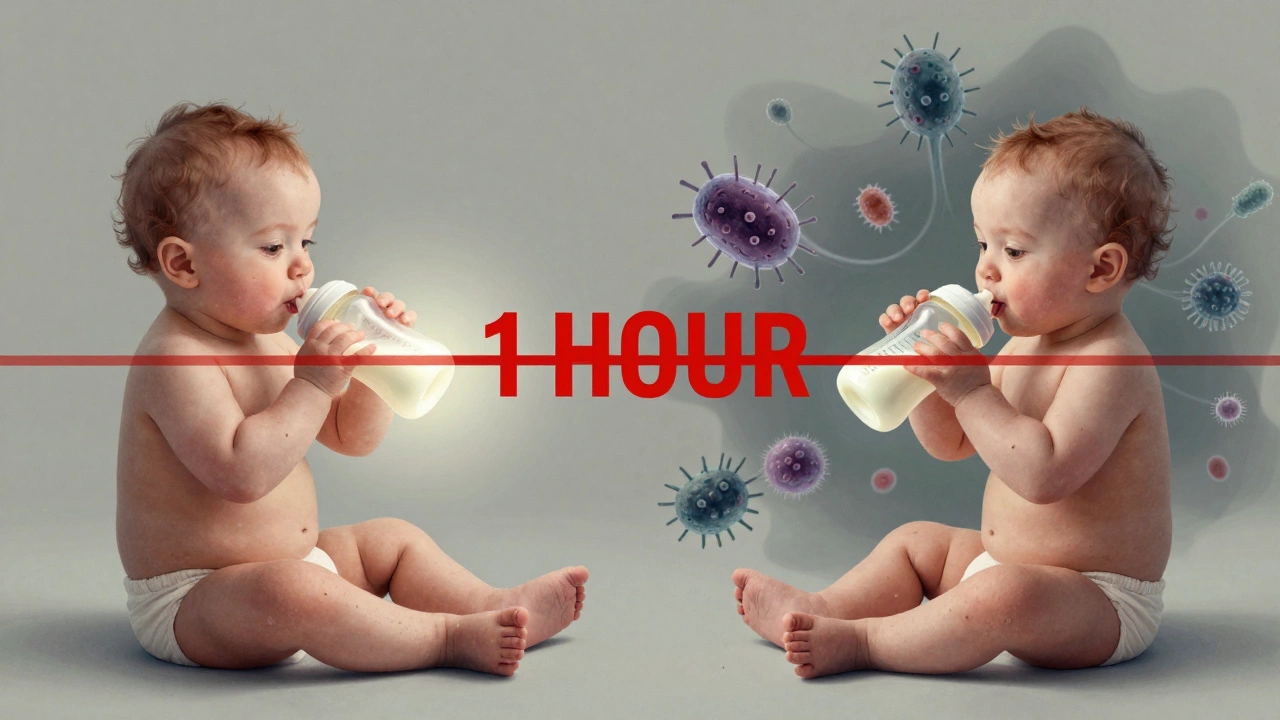
How to build a safe feeding routine
- Always wash your hands before handling bottles or milk.
- Sanitize bottles and nipples daily, especially in the first few months.
- Use clean, cool water to mix formula. Boil water if your tap isn’t safe.
- Keep prepared bottles refrigerated until use.
- Never leave bottles sitting out during playtime or naps.
- When in doubt, throw it out.
It’s not about being perfect. It’s about reducing risk. You don’t need to sterilize everything, but you do need to respect the one-hour window. It’s a simple rule that saves lives.
Common myths about bottle safety
Myth: "My baby drinks slowly, so I can save it."
Truth: Even if your baby takes 45 minutes to finish, the clock starts at the first sip. Bacteria don’t care how long it takes.
Myth: "I’ve done this for months and nothing happened."
Truth: Just because nothing bad happened yet doesn’t mean it won’t. Many serious infections happen without warning.
Myth: "Breast milk is natural, so it’s fine."
Truth: Breast milk has natural antibodies, but it doesn’t stop bacteria from multiplying once it’s out of the body.
Myth: "I’ll just give it to the older sibling."
Truth: Never reuse baby milk for another child. Older kids have stronger immune systems, but you’re still risking cross-contamination and waste.
Final reminder: When in doubt, toss it
There’s no such thing as "a little bit" of spoiled milk when it comes to babies. One hour is the line. Cross it, and you’re playing Russian roulette with your child’s health.
It’s easier to make fresh bottles than to deal with an emergency room visit. It’s cheaper to buy a little extra formula than to pay for hospital bills. And it’s far less stressful to have a clean bottle ready than to panic when your baby won’t eat and you’re out of options.
Keep it simple. One hour. No exceptions. Your baby’s health isn’t worth the gamble.
Can I refrigerate a bottle my baby didn’t finish?
No. Once your baby has started drinking from a bottle, bacteria from their mouth enter the milk. Refrigerating it won’t kill those bacteria or the toxins they produce. The CDC and AAP recommend discarding any bottle that’s been at room temperature for more than one hour, even if you put it in the fridge afterward.
How long can I keep formula or breast milk in the fridge?
Freshly prepared formula can be stored in the refrigerator for up to 24 hours. Expressed breast milk can last up to 4 days in the fridge. But once you take it out and warm it up, you have only one hour to feed it to your baby before it must be thrown away.
Is it safe to microwave a bottle to reheat it?
No. Microwaves heat liquids unevenly, creating dangerous hot spots that can burn your baby’s mouth and throat. Always warm bottles by placing them in a bowl of warm water or using a bottle warmer. Always shake the bottle well and test the temperature on your wrist before feeding.
Why can’t I use leftover milk for my older child?
Even though older children have stronger immune systems, leftover milk from a baby’s bottle may contain harmful bacteria that can spread to other surfaces or people. It’s also a hygiene risk-bacteria from one child’s mouth can transfer to another. Always dispose of unused milk after feeding.
Does the type of milk matter-breast milk vs. formula?
Both breast milk and formula are equally vulnerable to bacterial growth once exposed to air and saliva. Breast milk has natural antibacterial properties, but they don’t stop contamination after it leaves the body. The one-hour rule applies to both. Never assume one is safer than the other once it’s in a bottle.