
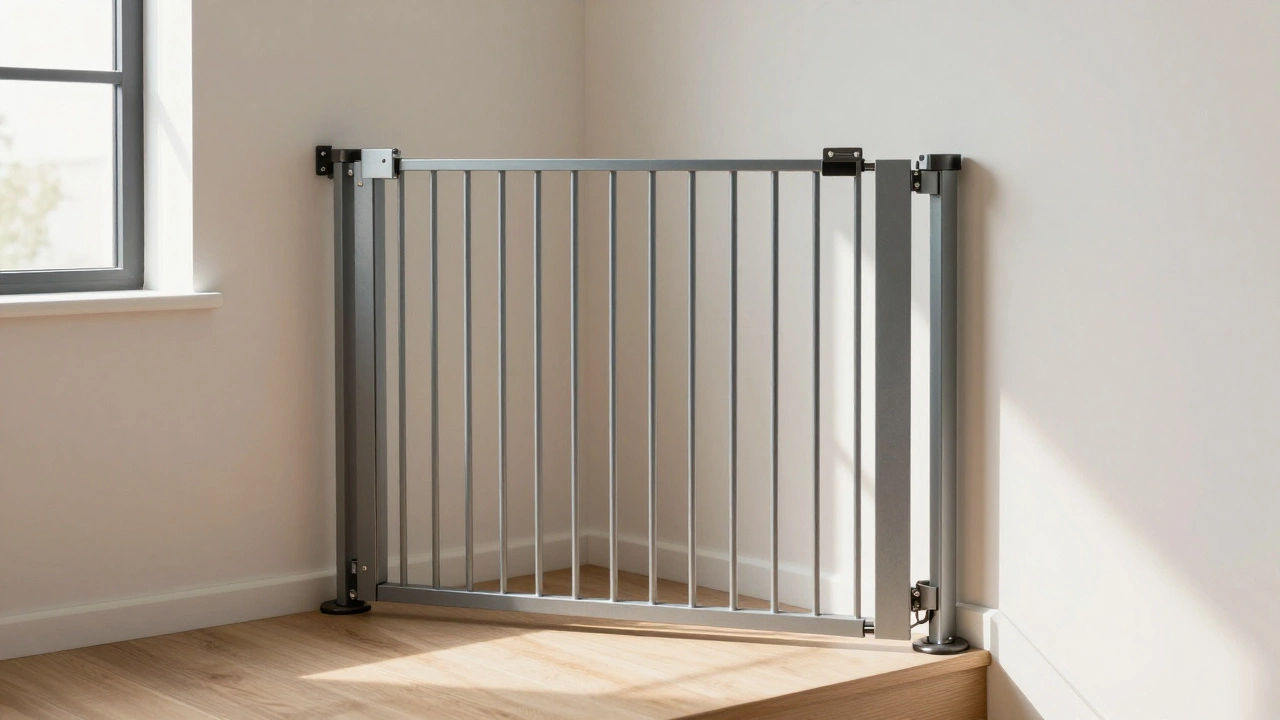
Mast Gate Compatibility Checker
Enter Your Measurements
Safety Requirements
For a mast gate to be safe and effective:
- Width must be between 28" and 48" 28-48"
- Height must be between 28" and 48" 28-48"
- Must attach to solid surface for stairs Required
- Slanted ceilings require adjustable top cap Optional
- Wall anchors needed for drywall Recommended
Ever seen a baby gate with a metal bar that swings open like a door and wondered how it actually stays in place? That’s a mast gate - and it’s one of the most reliable baby gates you can use, especially in doorways that don’t have solid walls on both sides. Unlike pressure-mounted gates that rely on tension, or hardware-mounted gates that need screws, a mast gate uses a sturdy post - called a mast - to anchor itself securely. It’s simple, strong, and perfect for homes with unique layouts.
What Is a Mast Gate?
A mast gate is a type of child safety gate that attaches to a vertical post, or mast, which is fixed to the floor and ceiling. This post acts like a pivot point, letting the gate swing open and closed like a door. The gate itself usually has a latch or lock mechanism on one side, and the mast holds the other end in place. You’ll often see these in stairways, wide doorways, or open-plan living areas where traditional gates won’t fit.
The mast is typically made of metal or heavy-duty plastic and is designed to be adjustable in height. Most models can extend from 28 inches up to 48 inches, which means they work for both standard doorways and taller openings. The gate panel is usually made of durable plastic or metal with narrow slats to prevent small heads or limbs from getting stuck.
How It Works: The Mechanics Behind the Design
Here’s how it actually functions in real life. First, you place the mast post vertically between the floor and ceiling. It’s not screwed in - instead, it uses a spring-loaded mechanism that expands when you twist or turn the top knob. This creates pressure against both surfaces, holding the mast firmly in place. Think of it like a tension rod you’d use in a shower, but built to handle much more force.
Once the mast is secure, you attach the gate to one side of the post using a hinge or pivot joint. The other side of the gate has a latch that connects to a wall, banister, or another fixed surface. Some models have dual latches - one on the mast side and one on the wall side - so you can open the gate from either direction.
When you want to open the gate, you simply press the release button or lift the latch. The gate swings open on its hinge, and when you close it, it clicks back into place. The mast doesn’t move. It stays put, which means the gate doesn’t wobble or shift under pressure. That’s why it’s so safe for crawling babies and toddlers who might push or climb on it.
Why Choose a Mast Gate Over Other Types?
Not all baby gates are created equal. Here’s how a mast gate stacks up against the two most common alternatives:
| Feature | Mast Gate | Pressure-Mounted Gate | Hardware-Mounted Gate |
|---|---|---|---|
| Installation | No drilling; uses tension post | No drilling; uses pressure only | Requires screws into wall |
| Stability | Very high - anchored top and bottom | Low to medium - can shift under pressure | Very high - permanently fixed |
| Best For | Wide openings, stairways, non-standard doorways | Narrow doorways, temporary use | Permanent installations, high-traffic areas |
| Portability | Easy to remove and reposition | Very portable | Not portable - permanently installed |
| Damage Risk | None - no screws | Potential wall marks | Permanent holes in walls |
Pressure-mounted gates are common because they’re cheap and easy to install. But they’re not strong enough for stairs or wide openings. If your toddler leans on it or tries to climb, it can pop out. Hardware-mounted gates are the gold standard for safety, but they require drilling holes - which isn’t ideal if you rent or don’t want to damage wood trim.
Mast gates give you the best of both worlds: the strength of a permanent gate without the permanent damage. They’re ideal for renters, homes with hardwood floors, or staircases where you need maximum stability.
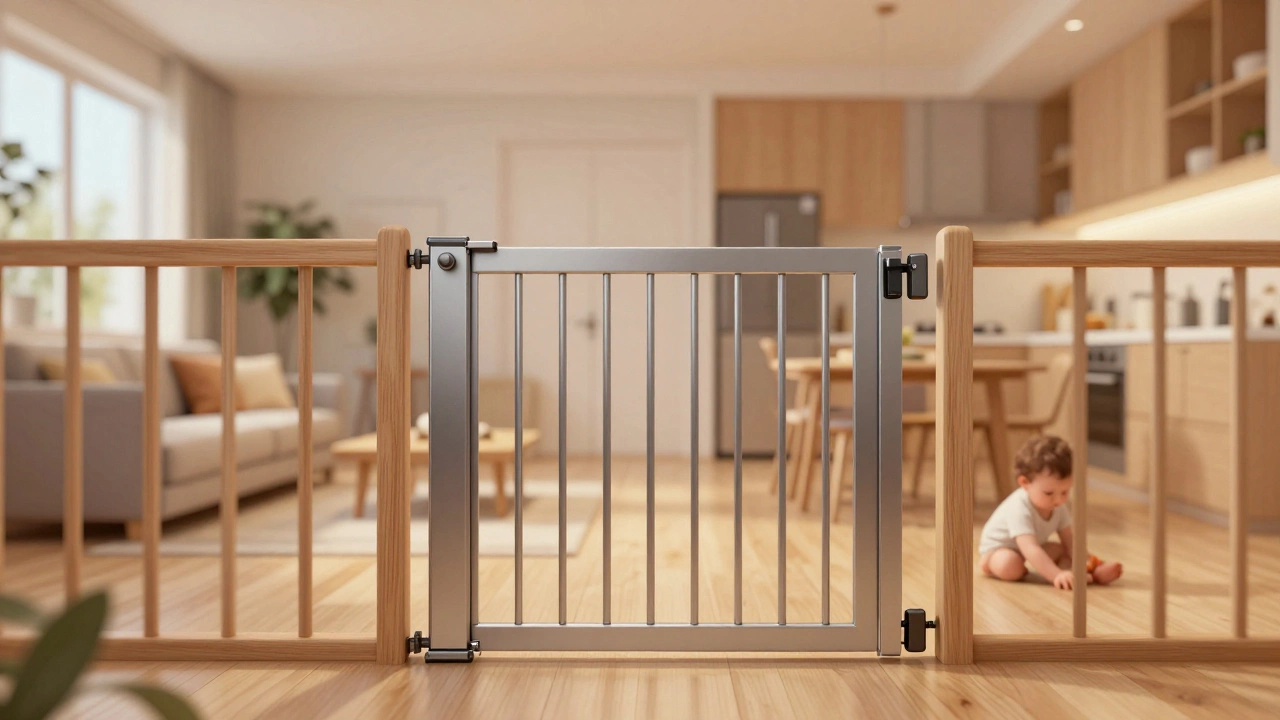
Where to Use a Mast Gate
You’ll find mast gates most useful in three situations:
- Stairways: The top and bottom of stairs are high-risk zones. A mast gate provides a solid barrier that won’t budge, even if your child pushes hard.
- Wide doorways: If your doorway is over 36 inches wide, most pressure gates won’t fit. A mast gate can span up to 48 inches easily.
- Open-plan homes: In homes where the kitchen opens into the living room, a mast gate can section off a play area without blocking natural light or airflow.
Some parents even use two mast gates - one at the bottom of the stairs and one at the top - to create a fully enclosed play zone. This is especially helpful if you have multiple levels and want to keep your baby safe while you cook or work.
Installation Tips
Installing a mast gate is straightforward, but there are a few things to get right:
- Measure first. Check the width of your opening and the height from floor to ceiling. Most masts adjust between 28 and 48 inches, but double-check the specs.
- Find a flat surface. The floor and ceiling should be level. If your ceiling is slanted (common in older homes), look for a mast gate with a pivoting top cap.
- Test the tension. After installing, give the mast a firm tug. It shouldn’t move. If it does, adjust the knob until it’s snug.
- Check the latch. Make sure the gate closes securely and that the latch can’t be easily undone by a curious toddler. Look for gates with double-lock mechanisms.
- Test with weight. Gently push on the gate from the child’s side. It should not swing open or bend. If it does, the mast isn’t tight enough.
What to Look for When Buying
Not all mast gates are built the same. Here’s what to check before you buy:
- Weight capacity: Look for gates rated for at least 50 pounds - enough for a toddler plus a little extra.
- Material: Metal frames are stronger than plastic. Look for powder-coated steel or reinforced polymer.
- Lock type: One-handed operation is a must. You’ll need to open it while carrying a baby or holding groceries.
- Auto-close feature: Some models swing shut automatically. This is a big safety plus.
- Certifications: Make sure it meets ASTM F1004 or EN 1930 safety standards. These are the gold standards in the US and Europe.
Brands like Summer Infant, Regalo, and Kidco offer reliable mast gates that meet these criteria. You can find them in most baby stores or online retailers - just search for "mast gate" or "tension-mounted gate with post."
Common Mistakes to Avoid
Even experienced parents make these mistakes:
- Using it on stairs without a wall anchor. If the gate only attaches to the mast and nothing else, it’s not safe for stairs. Always connect the latch side to a solid surface.
- Ignoring the gap. If the gate doesn’t fit tightly against the wall, your child can squeeze through. Use extenders or padding if needed.
- Not checking the mast regularly. Over time, the tension can loosen. Give it a quick twist every few weeks.
- Assuming it’s childproof. No gate is completely escape-proof. Always supervise young children near gates.
When Not to Use a Mast Gate
There are times when a mast gate isn’t the right choice:
- If you have a slanted ceiling and the gate doesn’t have an adjustable top cap.
- If the wall you’re attaching to is drywall with no stud - the latch needs something solid to grip.
- If your child is over 24 months and climbing - at that age, they might be able to lift or dislodge the gate. A hardware-mounted gate is safer.
- If you need a gate that opens both ways - some mast gates only swing in one direction.
In these cases, consider switching to a hardware-mounted gate or adding a secondary safety measure, like a baby monitor or playpen.
Final Thoughts
A mast gate isn’t just another baby gate - it’s a smart solution for homes that don’t fit the standard mold. It’s sturdy, flexible, and doesn’t ruin your walls. If you’ve struggled with pressure gates that slip or hardware gates that leave holes, this might be the answer you’ve been looking for.
Remember: safety isn’t about buying the most expensive gate. It’s about choosing the right one for your space - and checking it regularly. A mast gate gives you peace of mind because it doesn’t rely on guesswork. It’s built to hold.
Can a mast gate be used on stairs?
Yes, but only if the gate is securely attached to a solid surface on one side - like a wall, banister, or sturdy post. Never use a mast gate on stairs if it only connects to the mast and nothing else. The latch side must be anchored to prevent tipping or sliding.
Do mast gates damage walls?
No, they don’t. Unlike hardware-mounted gates, mast gates use a tension post between the floor and ceiling and attach to walls with a latch - not screws. This makes them ideal for renters or homes with hardwood, tile, or painted walls where you don’t want holes.
How tall should a mast gate be?
Most mast gates adjust between 28 and 48 inches. For toddlers, a height of at least 30 inches is recommended. If your child is climbing or trying to jump, go for the maximum height (48 inches) and make sure the latch is out of reach.
Are mast gates safe for babies under 12 months?
Yes, as long as the gate meets safety standards (ASTM F1004 or EN 1930) and is installed correctly. Babies under a year old can’t climb, so the main concern is ensuring the slats are narrow enough (less than 2.5 inches apart) to prevent head entrapment.
Can I use a mast gate outside?
Most mast gates are designed for indoor use. Outdoor exposure to rain, sun, and temperature changes can weaken materials over time. If you need a gate for a patio or deck, look for a weather-resistant model specifically labeled for outdoor use.