
Stair Safety Alternative Finder
Find Your Perfect Stair Safety Solution
Answer a few quick questions about your home and child to get personalized recommendations.
Stair gates are a go-to for parents worried about toddlers tumbling down the steps. But what if your stairs are too wide, oddly shaped, or you just hate the way they look blocking your hallway? Maybe your child figured out how to climb over it, or the gate keeps getting stuck. You’re not alone. Many parents in the UK, especially in older homes with narrow or curved staircases, are looking for real alternatives that work - without the hassle.
Why stair gates don’t always work
Stair gates are designed for standard, straight staircases with flat landings. But homes built before 1980 often have narrow, winding stairs, uneven treads, or open risers. A pressure-mounted gate might not hold under a determined 18-month-old. A hardware-mounted one can damage skirting boards or require drilling into expensive woodwork. And if your stairs open up into a living room or kitchen, a gate can feel like a prison wall - blocking sightlines and making the space feel smaller.
Some toddlers learn to undo the latch in under a week. Others use the gate as a climbing frame. A 2023 study from the UK’s Child Accident Prevention Trust found that 37% of stair-related injuries in under-fives happened despite a gate being in place. The gate was there, but it wasn’t enough.
Alternative 1: Full-height baby proofing railings
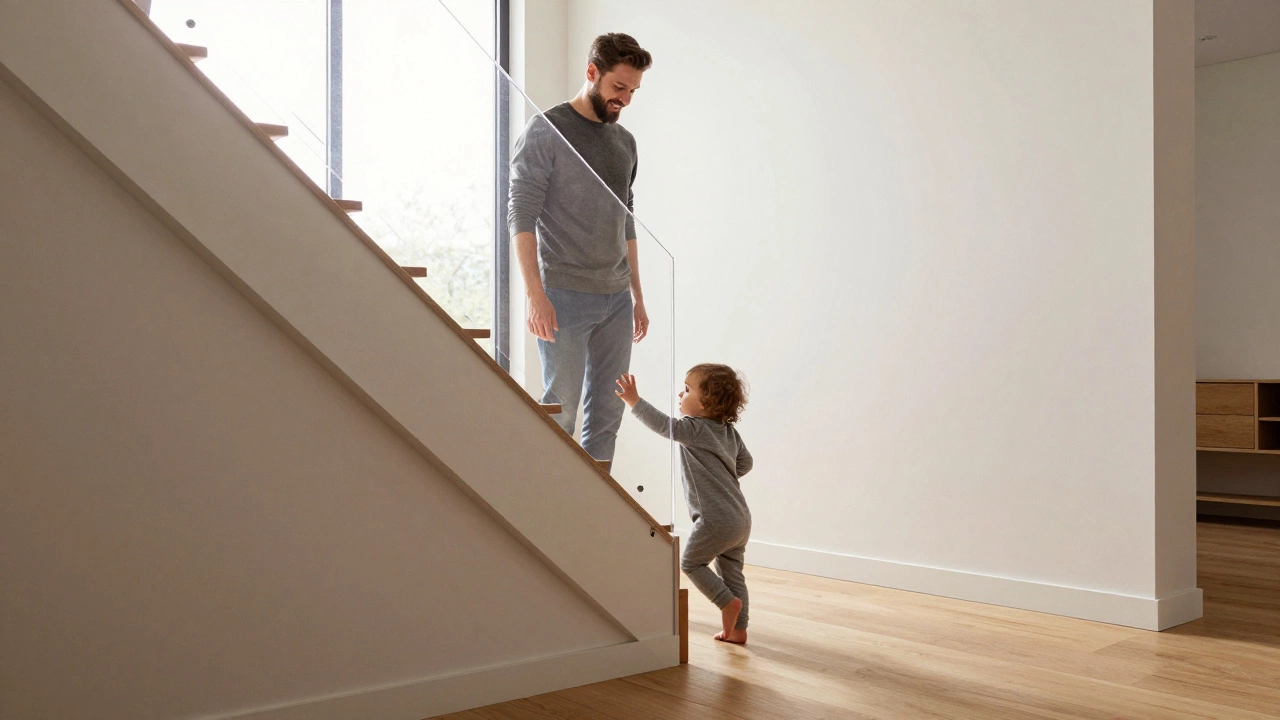
Think of these as transparent, sturdy barriers that attach directly to the wall and staircase posts. Made from clear polycarbonate or tempered glass, they’re nearly invisible from a distance. Unlike gates, they don’t swing open - they’re fixed. This means no latch to undo, no pressure to fail, and no climbing surface.
Brands like SafeTots a UK-based manufacturer of child-safe glass railings designed for staircases and BabyGuard Pro a modular railing system with no gaps wider than 2.5 inches offer systems that install with minimal drilling. They’re certified to EN 1930:2011, the European safety standard for barriers in homes with young children. Installation takes a day, and once done, you never have to think about it again.
They work best on straight runs of stairs with handrails on both sides. If your staircase has a turn, you can still install them in sections. They’re pricier than a gate - around £200 to £500 depending on length - but they last for years and add value to your home.
Alternative 2: Door alarms with automatic locking
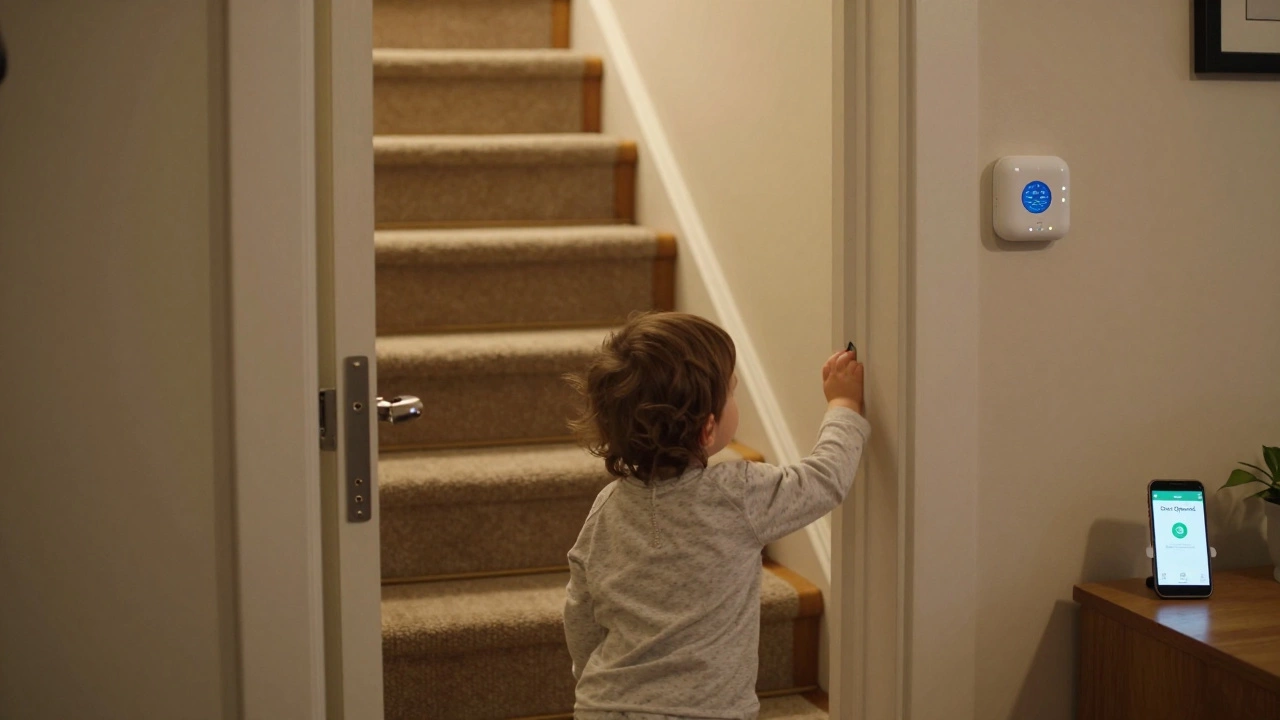
If your stairs lead to a basement or upper floor you want to keep off-limits, a simple solution is to install a door alarm on the bottom or top of the stairs. These aren’t just buzzers - modern ones like the BabyLock Smart Door Alarm a wireless, battery-powered door sensor with smartphone alerts connect to your phone and send a push notification the moment your toddler tries to open the door.
Pair it with a childproof door lock - the kind that requires a button press on the inside and a key or code on the outside. You can still get upstairs quickly, but your child can’t open the door alone. These systems are great for homes where stairs lead to a room with hazards - like a laundry room with washing machines or a garage with tools.
Installation is DIY-friendly. Most systems run on batteries and stick to the door frame with adhesive. No drilling. They cost between £30 and £70. You’ll still need to supervise, but now you’ll know the second your child tries to sneak up.
Alternative 3: Install a physical barrier with a gate at the top only
Here’s a trick many UK parents use: install one heavy-duty, hardware-mounted gate at the top of the stairs - and leave the bottom open. Toddlers can’t climb up if the gate is high enough (at least 30 inches) and locked. The bottom of the stairs is usually less dangerous because falls are short and often onto carpeted landings.
This setup works best in homes where the top landing is wide enough to keep the gate open without blocking a hallway. Use a gate with a one-handed release so you can carry groceries or a sleeping baby through easily. Look for models with a dual-lock system - both a slide lock and a swing lock - to prevent toddlers from figuring out how to open it.
Brands like Regalo a US-based brand with UK distribution, known for heavy-duty hardware gates and Summer Infant a trusted name in baby safety with gates rated for 36-inch openings offer gates that meet UK safety standards and can be mounted securely to banisters or walls.
Alternative 4: Use baby-proofing tape and visual cues
For homes with open-plan layouts or where physical barriers aren’t possible, some parents use high-contrast tape along the edge of each step. Bright yellow or red tape makes the step boundary obvious to toddlers who are just learning to walk. Combine this with a simple rule: "No climbing stairs without grown-ups."
This isn’t a substitute for a gate - it’s a behavioral tool. It works best with kids who respond to visual cues and routines. Pair it with positive reinforcement: "You waited for Mummy to come with you - well done!" Over time, your child learns to associate the tape with waiting.
Use non-slip, washable tape like StepSafe Pro a UK-made, non-toxic, peel-and-stick stair edge tape with anti-slip texture. It’s used in nurseries and care homes across the UK. Each roll covers 10 steps and costs under £15.
Alternative 5: Supervised freedom with a baby carrier or harness
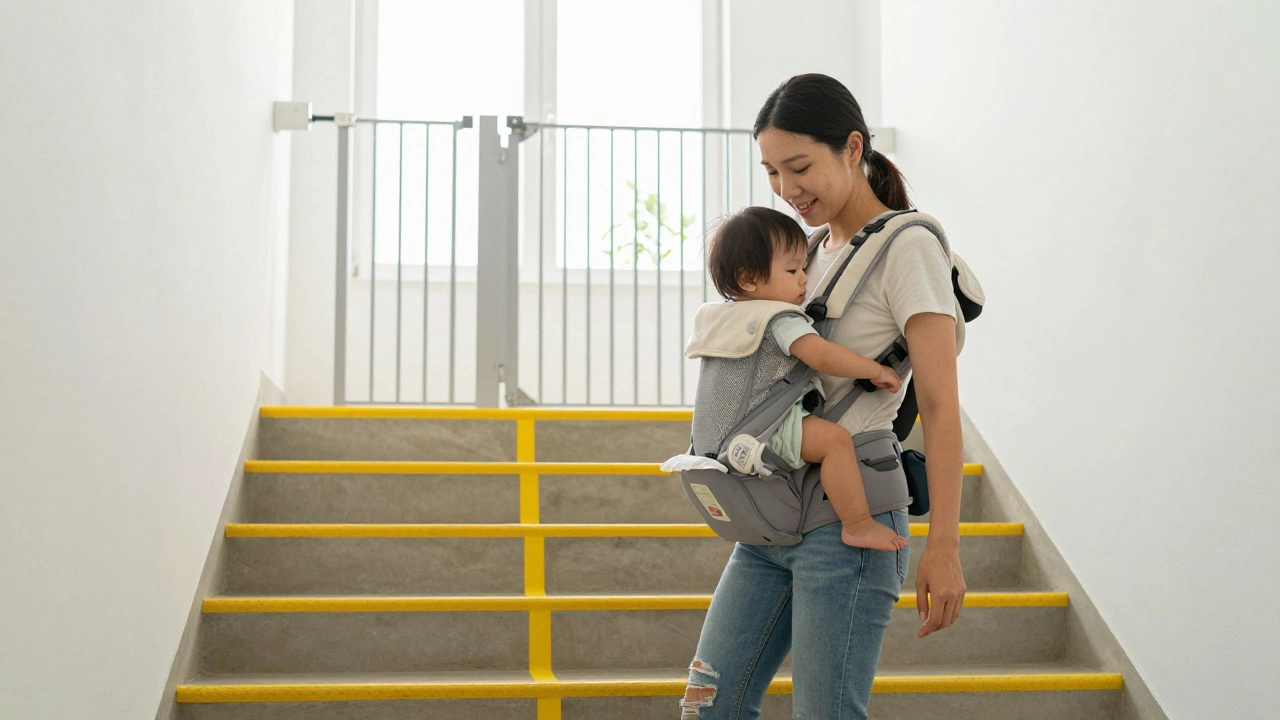
If you’re tired of fighting with gates and want to give your toddler more independence, try the old-school solution: carry them. A lightweight baby carrier like the Ergobaby Omni 360 a breathable, adjustable carrier suitable for toddlers up to 45 pounds lets you move freely while keeping your child close. For older toddlers who walk but still need support, a toddler harness - like the Walkie-Talkie Harness a soft, padded harness with a handle and adjustable straps for walking safety - gives you control without restricting movement.
This approach requires you to be present, but it builds trust. Your child learns to follow you up and down stairs, not fight against barriers. It’s especially useful in multi-level homes where stairs are used frequently throughout the day.
What doesn’t work
Don’t rely on baby gates that are too low, too flimsy, or only pressure-mounted. Avoid using furniture (like bookshelves or couches) as barriers - toddlers can climb them. Don’t install gates at the bottom of stairs unless they’re part of a larger safety plan. Bottom gates give a false sense of security and can be used as stepping stools.
Also skip the "just watch them" method. Even the most attentive parent can’t be everywhere at once. A toddler can fall in under a second.
Choosing the right solution for your home
Ask yourself these questions:
- Are your stairs straight or curved?
- Is there enough space to install a gate without blocking a doorway?
- Can you drill into the walls or banisters?
- Do you have the time to supervise constantly?
- Is your child a climber, a pusher, or a curious wanderer?
If you have a modern, straight staircase and want something permanent - go for glass railings. If you rent and can’t drill - try the door alarm + lock combo. If your child is 2+ and responsive to rules - try the tape + routine method. If you’re always carrying your toddler anyway - the harness might be your best bet.
Real-life example: A Bristol home renovation
One family in Clifton, Bristol, had a narrow, spiral staircase leading to their attic bedroom. A standard gate wouldn’t fit. They tried a pressure-mounted gate - it fell over every time their 16-month-old leaned on it. They ended up installing a custom polycarbonate railing on both sides of the stairs. Cost: £380. Installation: one day. Result: zero falls in 14 months. They also added a door alarm to the attic. Now, they can access the room freely, and their child knows the stairs are off-limits without help.
Final tip: Combine methods
The safest approach isn’t one solution - it’s layers. Use a physical barrier (like a railing) + a door alarm + a consistent routine. This way, if one thing fails, another catches it. Kids are smart. Safety systems should be smarter.
Can I use a baby gate on curved stairs?
Most standard baby gates won’t fit curved stairs. You need a custom solution - either a full-height railing system designed for curves, or multiple straight sections with connectors. Brands like SafeTots and BabyGuard Pro offer modular systems that can be bent to fit most curved staircases. Pressure-mounted gates are unsafe on curves because they can’t grip evenly.
Are glass railings safe for toddlers?
Yes, if they’re made from tempered glass or polycarbonate and installed to meet EN 1930:2011 standards. These materials won’t shatter like regular glass - they break into small, dull pieces if impacted. The gaps between panels are kept under 2.5 inches, so a child’s head or body can’t fit through. They’re used in nurseries, hospitals, and public buildings across the UK.
What’s the cheapest alternative to a stair gate?
Baby-proofing stair edge tape is the most affordable option - under £15 for a full set. It won’t stop a determined climber, but it improves visibility and works well with supervision and routines. Pair it with a door alarm (around £40) for a low-cost, layered safety system.
Can I use a pet gate for my toddler?
No. Pet gates are not tested for child safety. They’re usually lower, less sturdy, and lack the locking mechanisms required for toddlers. A child can easily climb over or push through a pet gate. Always use products certified to EN 1930:2011 or equivalent child safety standards.
When should I stop using stair safety measures?
Most children develop the motor skills to safely use stairs around age 3. But it depends on the child. Watch for signs: can they go up and down stairs one foot per step without holding on? Do they understand the rule "wait for grown-ups"? If yes, you can start phasing out barriers. Always keep a door alarm in place until age 4 or 5 - accidents still happen even when kids think they’re ready.